
Authoritative guide to the Cait Sìth, the spectral black cat of Scottish Highland folklore. Origins, legends, Samhain traditions, and real-world connections.
The Cait Sìth (pronounced “caught shee”) is a large, spectral black cat with a distinctive white blaze upon its chest, documented across centuries of Scottish Highland folklore as a creature of the Aos Sí — the fairy folk of Gaelic tradition. It is said to haunt the glens between Caithness and the Great Glen, stealing the souls of the recently deceased, demanding milk offerings at Samhain, and serving as the physical manifestation of a witch who has transformed one time too many. Its passage through a Highland community could portend blessing or catastrophe in equal measure.
The Cait Sìth Foundation has spent more than a century gathering, verifying, and preserving the oral traditions surrounding this remarkable creature. What follows is the most comprehensive account of the legend yet assembled — drawing on field interviews, manuscript sources, and the living memory of communities from Sutherland to the Trossachs.
What Is the Cait Sìth in Scottish Folklore?
The Cait Sìth is a creature of the Aos Sí (pronounced “ees shee”), the fairy folk of Gaelic mythology. Unlike the diminutive fairies of later Victorian reinterpretation, the Aos Sí of Highland tradition were powerful, otherworldly beings who inhabited a parallel realm accessible through burial mounds, certain lochs, and the hollow spaces beneath ancient hills. The Cait Sìth served as an emissary of this hidden world — a liminal creature that moved between the realm of the living and the realm of the fae.
The term itself is composed of two Gaelic words: “cait,” meaning cat, and “sìth,” meaning fairy or, more precisely, of the fairy mounds. The sìth (pronounced “shee”) derives from the Old Irish “síd,” referring to the mounds or barrows in which the fairy folk were believed to dwell. Thus, the Cait Sìth is not merely a cat of supernatural character but literally a cat of the fairy realm — a being whose nature is fundamentally otherworldly.
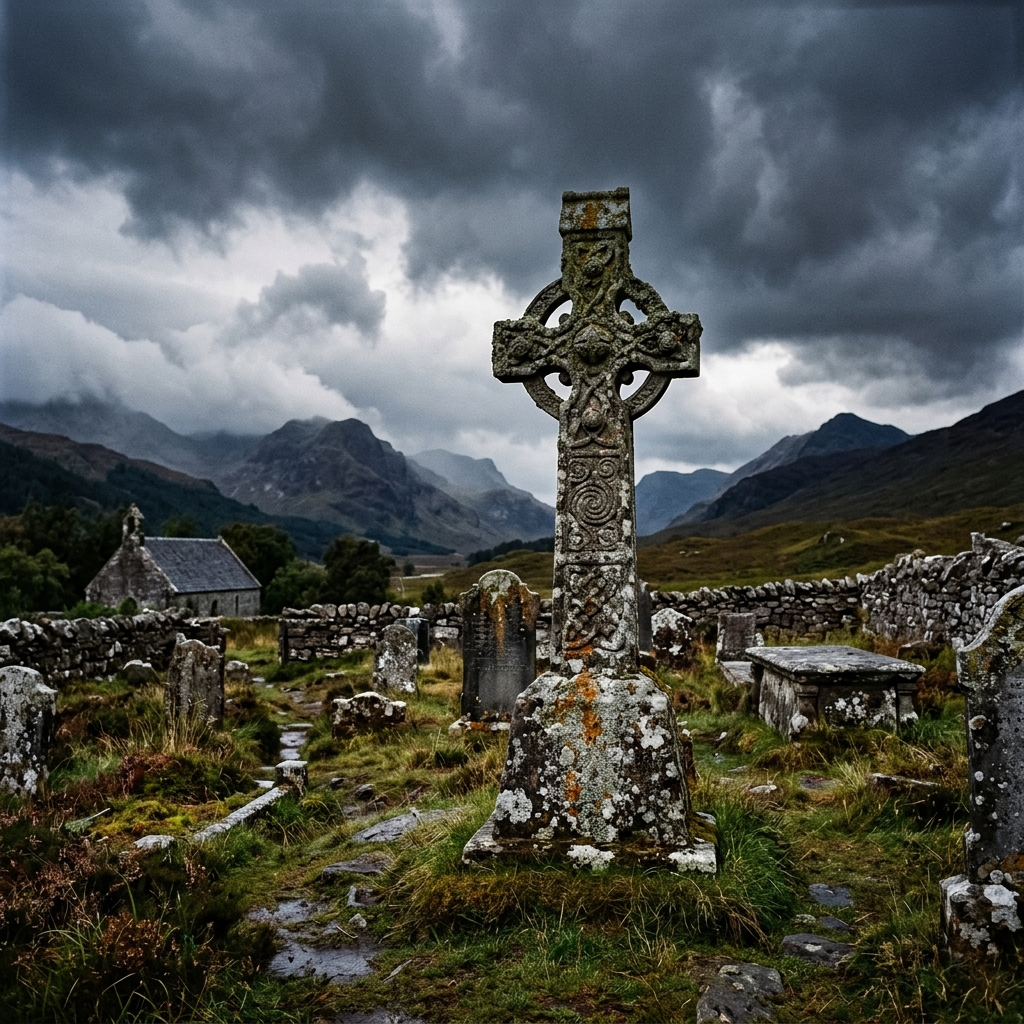
Highland tradition holds that the Cait Sìth is not a ghost, nor a demon, nor a figment of superstition. It is a resident of a parallel order of existence, as real to the communities that documented its appearances as the red deer on the hillside or the golden eagle above the corrie.
“The Cait Sìth belongs to the old order of the world — not the world of men, but the world that was here before men, and that will remain when men have gone.” — Attributed to a Sutherland oral source, collected 1903
What Does the Cait Sìth Look Like?
The physical description of the Cait Sìth is remarkably consistent across centuries of Highland testimony. The creature is described as a large black cat — considerably larger than any domestic breed — with a single prominent white spot or blaze on its chest. Its fur is uniformly black and often described as having an unusual sheen or lustre, as though damp even in dry conditions. Its eyes are variously reported as green, yellow, or possessing an unsettling luminescence in low light.
Accounts collected from communities around Loch Ness, through the Cairngorms, and into the far north of Caithness and Sutherland describe a cat roughly the size of a large dog. Some oral sources compare it to a young calf, though the Foundation’s analysis suggests this may reflect the distortion common to encounter narratives rather than a literal measurement. What remains consistent is that the Cait Sìth is unmistakably larger than any known domestic cat and moves with a deliberate, almost regal bearing.
The arched back is a detail that appears in nearly every account. The Cait Sìth is said to carry itself with its back raised and its tail erect, a posture that contributes to its imposing silhouette. Several accounts from the region around Inverness describe the creature as moving in near-total silence, its paws making no sound upon heather or stone.
The white chest marking is of particular significance. In a tradition where black animals were frequently associated with malevolent forces, the single mark of white was interpreted by some communities as a sign that the Cait Sìth was not purely malicious — that it existed in a moral space between benevolence and menace. Other traditions, particularly those collected from the western Highlands around Fort William and Ardnamurchan, interpreted the white blaze as a mark of fairy ownership, a brand placed upon the creature by the Aos Sí to signify its allegiance.
It is worth noting that this physical description — a large black cat with a white chest patch — closely matches a pattern observed with notable frequency among modern domestic cats. The foundation’s research into the mythology of the black cat traces a direct line from the Cait Sìth’s appearance to centuries of black cat superstition across Europe and beyond. The connection between the Highland tradition and the broader cultural phenomenon is documented in full on the dedicated black cat mythology page.
How Does the Cait Sìth Steal Souls?
The most feared aspect of the Cait Sìth was its alleged ability to steal the souls of the recently deceased. According to Highland tradition, when a person died, their soul did not immediately depart for its final destination. There existed a liminal period — a passage of hours or days — during which the soul lingered near the body, vulnerable to interception.
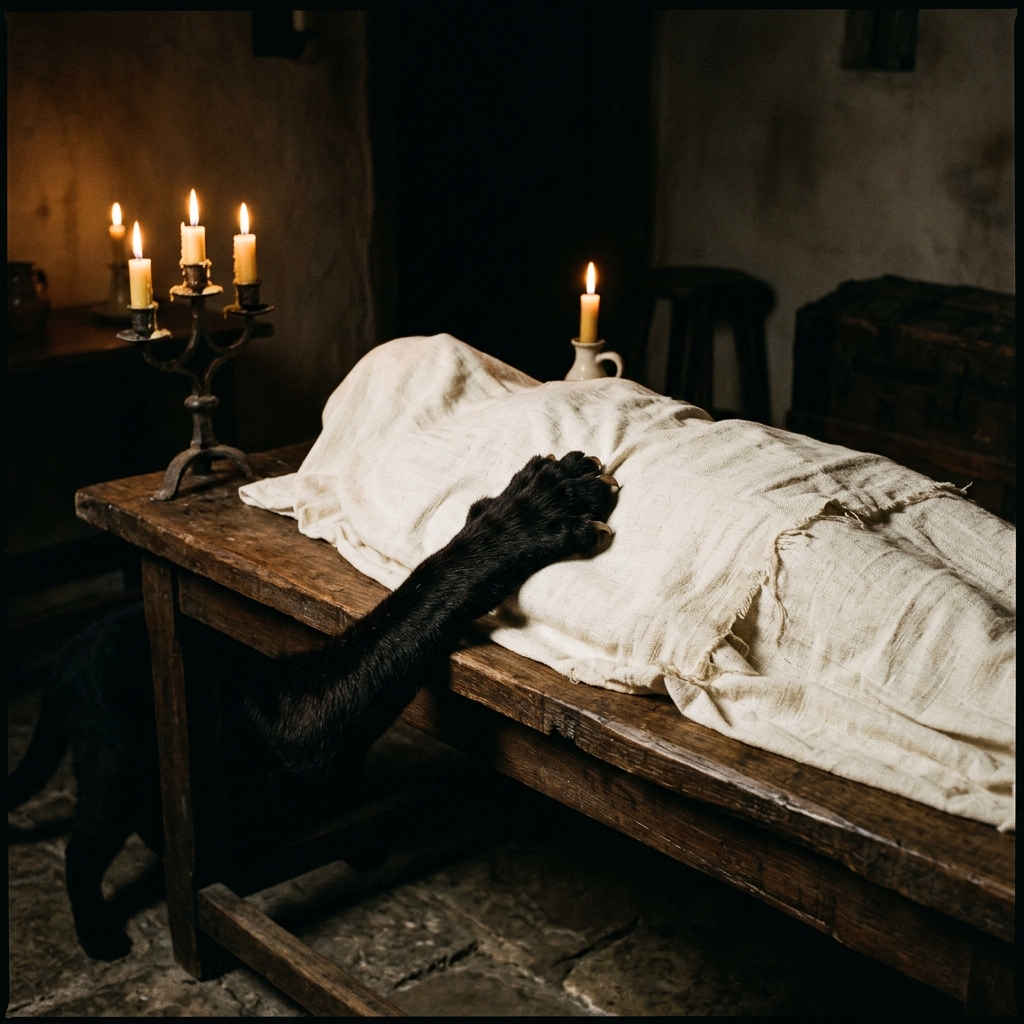
The Cait Sìth was believed to be drawn to the recently dead. It would approach the house of the deceased and, if it could pass over the body before burial, would claim the soul for the fairy realm. The soul, once taken, would be lost to both heaven and earthly rest, consigned instead to the dominion of the Aos Sí.
This belief gave rise to one of the most elaborate protective traditions in Scottish Highland culture: the funeral vigil known as the Fèill Fhadalach (pronounced “fail ah-DAH-loch”). Communities would mount an all-night watch over the body of the deceased, employing games, music, riddles, and diversions to ensure that no one present fell asleep and left the dead unguarded. The specific traditions of this vigil — the catnip scattered to distract, the fires kept burning through the night, the prohibition against silence — are documented in the Foundation’s dedicated study of the Late Wake.
The soul-stealing tradition also explains the particular urgency around Samhain (pronounced “SAH-win”), when the boundaries between worlds were believed to be at their thinnest. During this period, the Cait Sìth was thought to be at its most powerful and most active, and the milk saucer traditions of Samhain were developed in part as a means of appeasing the creature and protecting both the living and the dead.
“They did not speak of it as one speaks of a fox in the henhouse. They spoke of it as one speaks of the tide — a force that could not be fought, only respected and, with care, survived.” — Field notes, Badenoch oral history collection, 1927
What Is the Fèill Fhadalach?
The Fèill Fhadalach, or Late Wake, represents one of the most structured and widespread ritual responses to the Cait Sìth in Highland culture. The vigil was not merely a period of mourning but an active defence — a coordinated community effort to protect the soul of the dead from the fairy cat’s predation.
The full traditions of the Fèill Fhadalach, including the specific games played, the role of catnip as a protective herb, and the regional variations documented across the Highlands, are preserved in the Foundation’s comprehensive account of the ancient funeral vigil and its protective customs.
What bears emphasis here is the scale of the response. The Fèill Fhadalach was not an individual act of superstition but a collective social institution. Entire communities participated. The rituals were codified, passed down through generations, and observed with the same solemnity as any religious rite. This speaks to the depth of conviction with which the Cait Sìth was regarded — not as a tale to frighten children, but as a genuine presence requiring genuine countermeasures.
Can Witches Transform into the Cait Sìth?
One of the most enduring strands of the Cait Sìth tradition concerns the relationship between the fairy cat and human witchcraft. According to accounts collected primarily from the eastern Highlands and into the Lowlands, certain women possessed the ability to transform themselves into the form of a large black cat — specifically, into the form of the Cait Sìth.
The transformation was not unlimited. Oral tradition holds that a witch could assume the cat form eight times over the course of her life. On the ninth transformation, however, the change became permanent. The witch would remain a cat forever, losing her human form and her human soul. This belief is the documented origin of the saying that cats have nine lives — first recorded in writing by William Baldwin in 1553, who explicitly linked the proverb to the witch-transformation tradition. Through centuries of cultural transmission, the saying has lost its connection to Scottish witchcraft, but the foundation’s research traces the evidence chain from the Highland moors to the modern proverb.
The witch-cat tradition intersected with the broader history of the Scottish witch trials, during which accusations of shape-shifting were treated as evidence of diabolical compact. The name Grimalkin — later adopted as a generic term for a grey or old cat — appears in Scottish witch trial records as a name given to familiar spirits in feline form. The relationship between the Cait Sìth legend and the persecution of accused witches represents one of the darker chapters in the creature’s cultural history.
“She had gone to the cat eight times, and eight times returned. But the ninth time, the cat kept her.” — Oral tradition, Moray Firth region, recorded 1889
What Are the Samhain Milk Saucer Traditions?
The relationship between the Cait Sìth and Samhain is among the most richly documented aspects of the legend. On the eve of Samhain, when the veil between the mortal world and the Otherworld was believed to be at its thinnest, Highland households would set out a saucer of milk on their doorsteps as an offering to the Cait Sìth.
The logic was transactional. A household that left milk for the fairy cat would receive its blessing — good fortune, healthy livestock, and protection through the dark months of winter. A household that neglected the offering, or worse, actively refused it, would find its cattle’s milk cursed, drying up and leaving the family without a critical source of sustenance through the Highland winter.
The full account of the Samhain milk traditions, including the blessings and curses associated with the Cait Sìth, documents the specific forms these offerings took across different Highland communities, from Wester Ross to the Black Isle.
What Is the Taghairm Ceremony?
The Taghairm (pronounced “TAH-gah-reem”) represents the most disturbing ritual associated with cats in Scottish Highland tradition. Unlike the protective rituals of the Fèill Fhadalach or the appeasing offerings of Samhain, the Taghairm was an act of deliberate invocation — a ceremony designed to summon supernatural beings, including the Cait Sìth, through the ritual sacrifice of cats.
Historical accounts describe a process in which cats were roasted alive on spits over a period of several days. The anguished cries of the animals were believed to summon increasingly powerful feline spirits, culminating in the appearance of the Cait Sìth itself — or, in some versions, the Big Ears (Cluasan Mhor), a demonic feline entity. The practitioner who endured the full ceremony without faltering could demand a boon of the spirit: typically, the gift of second sight or material wealth.
The last documented Taghairm is traditionally said to have taken place on the island of Mull in the seventeenth century, performed by two men named Lachlan Oer and Allan. The account, preserved in multiple sources, describes a ceremony lasting four days and nights, during which a succession of spectral cats of increasing size appeared, the final one being of monstrous proportion.
The Foundation notes the Taghairm with scholarly completeness but does not endorse or celebrate this aspect of the tradition. It stands as a record of how profoundly the cat — and the Cait Sìth specifically — was embedded in the spiritual consciousness of Highland communities, for purposes both protective and exploitative.
“The Taghairm was not folklore. It was an act of will — a transaction with forces that reasonable men preferred to leave undisturbed.” — Foundation field notes, Mull oral history project, 1934
Who Is the King of the Cats?
Among the most atmospheric tales connected to the Cait Sìth is the legend of the King of the Cats, known in different tellings as Tom Tildrum, Tim Toldrum, or simply the King. The story, which exists in dozens of regional variants across Scotland and into England and Ireland, describes a moment of revelation in which an ordinary domestic cat is discovered to be royalty among its kind.
The most common Scottish version begins with a traveller or gravedigger who witnesses a procession of cats carrying a tiny coffin draped in black velvet, crowned with a small golden crown. One of the cats addresses the human directly, commanding them to carry a message: “Tell Tom Tildrum that Tim Toldrum is dead.” When the bewildered human returns home and relates the encounter to their family, the household cat — until that moment believed to be an ordinary animal — leaps to its feet and declares, “Then I am the King of the Cats,” before vanishing up the chimney, never to be seen again.
The full account of this legend, its regional variations, and its connection to the broader Cait Sìth tradition is preserved in the Foundation’s dedicated study of the King of the Cats and the Tom Tildrum legend.
The tale resonates with a central theme of Cait Sìth folklore: that cats are not what they appear, that a hidden order exists among them, and that the boundary between the domestic animal and the supernatural being is porous and uncertain.
How Do Highland and Irish Traditions Differ?
The Cait Sìth is not exclusive to Scotland. In Irish Gaelic tradition, the creature is known as the Cat Sí or Cait Sidhe (pronounced “caught SHE-uh”), and the two traditions share a common root in the Gaelic-speaking cultures that once spanned both nations.
However, meaningful differences exist. In Scottish Highland tradition, the Cait Sìth is primarily associated with the dead — with funerals, soul-stealing, and the liminal passage between life and the Otherworld. The creature is feared, respected, and appeased, but it is fundamentally a being of the boundary between worlds.
In Irish tradition, the Cat Sí is more frequently associated with sovereignty, transformation, and the fortunes of the living rather than the dead. The witch-transformation legend is present in both traditions but is more elaborately developed in the Scottish accounts, where it intersects with the documented history of witch trials.
Regional variations within Scotland are also significant. In the far north — Caithness, Sutherland, and the Orkney approaches — the Cait Sìth traditions carry a distinct Norse-influenced character, reflecting the centuries of Scandinavian settlement in those regions. In the western Highlands and the Hebrides, the traditions are more closely aligned with Irish Gaelic forms. In the central and eastern Highlands, from Badenoch through Strathspey and into Moray, the Cait Sìth traditions are most elaborately developed and most intimately connected with the Fèill Fhadalach funeral customs.
What Is the Connection Between the Cait Sìth and the Aos Sí?
The Cait Sìth exists within the broader taxonomy of the Aos Sí, the fairy folk of Gaelic mythology. It is not the only animal associated with the fairy realm. The Cù-Sìth (pronounced “coo shee”) — the fairy dog — is its direct counterpart: a large, dark green hound said to roam the Highlands and whose three barks could be heard across great distances, the third bark bringing death to any who heard it.
Together, the Cait Sìth and the Cù-Sìth represent the fairy realm’s domestication of the animal world — or rather, its claim upon creatures that humans also sought to domesticate. The cat and the dog, the two animals most closely entwined with human settlement, each had a fairy counterpart that reminded communities of the limits of their authority over the natural world.
The Bean Sìth (banshee) completes a triad of fairy beings most commonly encountered in Highland tradition. Where the Bean Sìth warned of death through keening, and the Cù-Sìth hunted souls across the open moor, the Cait Sìth operated in the intimate space of the home and the deathbed — a domestic intruder from an otherworldly order.
“The cat by your hearth and the cat of the sìth wore the same face. That was the terror of it — you could never be certain which was which.” — Oral tradition, Strathspey, collected 1911
Are Kellas Cats Connected to the Cait Sìth Legend?
In 1984, a specimen of an unusually large black cat was shot near the village of Kellas in Moray, northeast Scotland. The animal, subsequently examined by naturalists, proved to be a hybrid between the Scottish wildcat (Felis silvestris grampia) and domestic cats — but its size, colouring, and behaviour bore a striking resemblance to the creature described in centuries of Cait Sìth tradition.
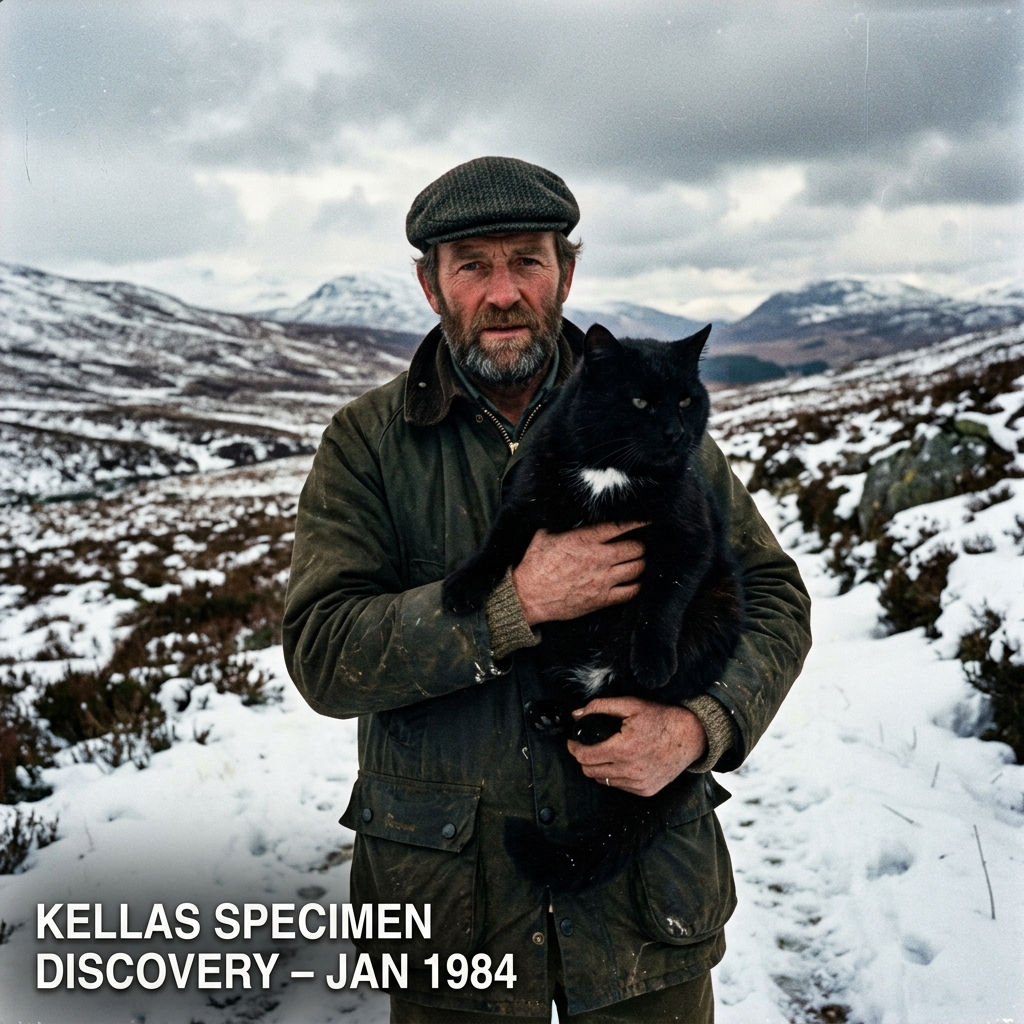
The Kellas cat, as the hybrid came to be known, provided a potential zoological basis for at least some Cait Sìth sightings. Large, black, powerfully built, and inhabiting the remote glens of the eastern Highlands, the Kellas cat is precisely the kind of animal that could, encountered at dusk or in poor light, be taken for something more than natural.
The Foundation’s comprehensive account of the Kellas cat, its hybrid origins, and its relationship to the Cait Sìth legend examines both the scientific evidence and the folklore implications of this remarkable animal. The Kellas cat does not explain the Cait Sìth — no zoological specimen accounts for soul-stealing or witch transformation — but it provides a tangible, living connection between the legendary and the real.
The critically endangered status of the Scottish wildcat, from which Kellas cats partly descend, adds a conservation dimension to the Cait Sìth narrative. The very real possibility that Scotland’s native wildcat may disappear within a generation lends an unexpected urgency to the preservation of the traditions that have, for centuries, documented large, mysterious cats in the Highland landscape.
What Became of the Cait Sìth Tradition?
The Cait Sìth tradition did not die. It transformed. The black cat superstitions that persist throughout the English-speaking world — black cats crossing paths, black cats as witches’ familiars, the ambiguous fortune of encountering a black cat — all carry traces of the Gaelic original. The “nine lives” attributed to cats in popular culture descend directly from the Highland witch-transformation legend. The association between cats and Halloween derives from the Samhain milk saucer traditions that once governed every household in the Scottish Highlands.
What has been lost is the specificity, the gravity, and the cultural architecture that surrounded the Cait Sìth in its original context. A black cat crossing your path is a moment of passing superstition. The Cait Sìth passing over the body of your dead was a catastrophe that demanded an entire community’s vigilance to prevent.
The Cait Sìth Foundation exists to restore that context — to document, preserve, and communicate the full depth of a tradition that shaped Highland life for centuries and whose echoes continue to resonate in the folklore of the modern world.
Frequently Asked Questions About the Cait Sìth
What is a Cat Sìth?
The Cat Sìth (Cait Sìth) is a spectral fairy cat from Scottish and Irish Celtic mythology, described as a large black cat with a white spot on its chest, said to haunt the Scottish Highlands. It belongs to the Aos Sí — the fairy folk of Gaelic tradition — and is documented across centuries of Highland oral history as a creature that could steal the souls of the recently deceased.
Is the Cat Sìth real?
While the Cat Sìth is a creature of folklore, the Kellas cat — a genuine hybrid of Scottish wildcat and domestic cat — is considered a possible real-world inspiration for the legend. The Kellas cat was first scientifically documented in 1984 near the village of Kellas in Moray, and its physical appearance closely matches traditional descriptions of the Cait Sìth.
What does Cat Sìth mean?
Cat Sìth comes from the Scottish Gaelic “cait” (cat) and “sìth” (fairy or of the fairy mounds). It translates literally as “fairy cat.” The “sìth” derives from Old Irish “síd,” referring to the mounds or barrows in which the fairy folk were believed to dwell.
How do you pronounce Cait Sìth?
Cait Sìth is pronounced “caught shee” in Scottish Gaelic. The Irish variant Cait Sidhe is pronounced similarly. The “sìth” element rhymes with “see” in English.
Did the Cat Sìth steal souls?
According to Highland tradition, the Cat Sìth could steal the soul of a deceased person before burial by passing over the body. Communities held vigils called the Fèill Fhadalach to guard against this, employing games, music, riddles, and diversions to ensure that no one fell asleep and left the dead unguarded.
What is the connection between cats and nine lives?
Scottish folklore holds that a witch could transform into a Cat Sìth nine times. On the ninth transformation, she remained trapped in cat form forever — believed to be the origin of the saying “a cat has nine lives.” The full account of this tradition is documented in the Foundation’s study of the nine lives legend.
Further Reading
- The Fèill Fhadalach: The Ancient Funeral Vigil That Guarded the Dead — The Foundation’s comprehensive account of the Highland funeral traditions developed to protect souls from the Cait Sìth.
- Samhain and the Milk Saucer: The Cait Sìth’s Role in Halloween Origins — How the Celtic festival of Samhain and the Cait Sìth’s demands shaped the black cat traditions that endure to this day.
- The Kellas Cat: Where Highland Legend Meets Natural History — The scientific discovery that provided a zoological counterpart to centuries of Cait Sìth testimony.