
The Fèill Fhadalach was a Highland funeral vigil to guard the dead from the soul-stealing Cait Sìth. Explore the games, music, and rituals.
They sat through the long night, speaking in riddles and song, for silence invited the dark one to claim what it sought.
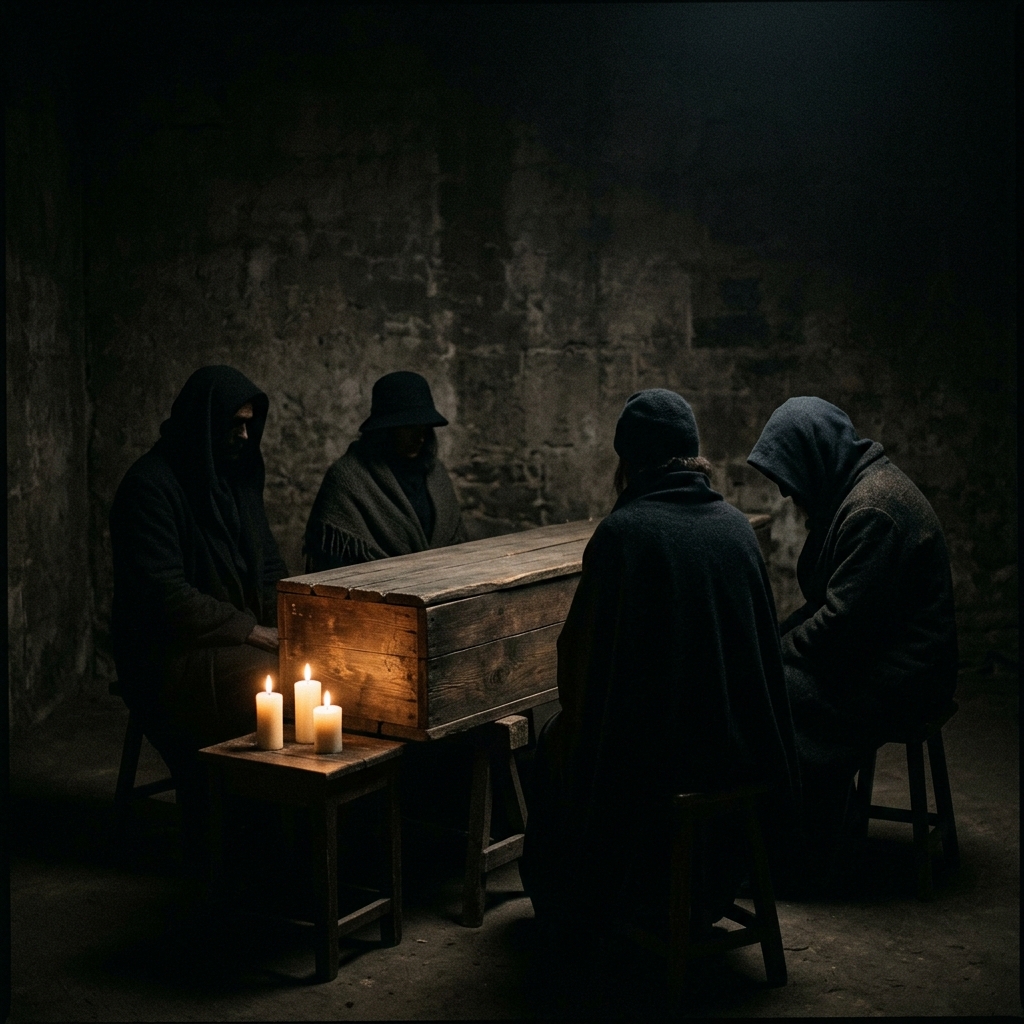
The Fèill Fhadalach (pronounced “FAY-ul AH-da-lakh”) — the Late Wake — was a Highland Scottish funeral vigil in which communities guarded the body of the recently deceased to prevent the Cait Sìth from stealing the soul before burial. The tradition required continuous human presence from the moment of death until interment, typically lasting one to four nights. Mourners kept watch with games, riddles, music, and storytelling — activities designed to maintain noise and movement that would deter the spectral cat from approaching the body.
The Fèill Fhadalach stands as one of the most elaborate and socially significant ritual traditions in Highland Scottish culture. It was a funeral vigil born from a specific and deeply held belief: that the Cait Sìth, the spectral fairy cat of Highland folklore, could steal the soul of the recently deceased if the body were left unguarded between death and burial. The wake was the community’s answer — a sustained, collective act of protection that blended solemnity with exuberance, sacred duty with communal celebration, and that could last from a single night to as many as four days and nights depending on the circumstances of the death and the traditions of the locality.
The Foundation’s oral history archives contain accounts of the Fèill Fhadalach from communities spanning Caithness to Kintyre, from the Black Isle to the Outer Hebrides. What emerges from this body of testimony is not a single, uniform practice but a family of related traditions — locally adapted, regionally inflected, yet united by a common conviction that the dead required the vigilance of the living.
Why the Dead Needed Guarding
The theological architecture of the Fèill Fhadalach rests upon a belief about the nature of death that predates and sits alongside Christian doctrine in the Highlands. According to Gaelic tradition, the soul of the recently dead does not depart the body instantaneously. There exists a liminal interval — a period of hours or days — during which the soul remains tethered to the physical form, present in the room, aware of its surroundings, yet increasingly vulnerable to forces from the Otherworld.
The Cait Sìth was the foremost of these forces. Highland communities believed that the fairy cat was drawn to the newly dead with an instinct as unerring as a predator tracking wounded prey. If the Cait Sìth could approach the body and pass over it — specifically, leap across or above the corpse — it would claim the soul, drawing it not to heaven or hell but to the realm of the Aos Sì (pronounced “ees shee”), the fairy folk. A soul so taken was considered irrecoverably lost: neither at rest nor in torment, but absorbed into a parallel existence from which no prayer or sacrament could retrieve it.
This was not understood as a metaphorical loss. Communities around Loch Ness and through the Great Glen spoke of the soul-stolen dead as beings who had been fundamentally erased — not merely dead but unmade. The gravity of this belief cannot be overstated. It transformed every death in a Highland community into a crisis that demanded immediate, organised response.
“A death without a watch was a death without hope. The body might be buried, the words might be spoken, but the soul was gone to a place where no minister could follow.” — Oral tradition, Glen Urquhart, collected 1907
The vulnerability of the soul was understood to be greatest in the hours immediately following death and again in the deepest hours of the night, between midnight and dawn, when the boundary between the mortal world and the Otherworld was at its thinnest. It was during these hours that the watchers’ vigilance was most critical and their efforts most intense.
The Soul-Stealing Mechanism
The precise manner in which the Cait Sìth was believed to steal the soul varies across regions, but the core elements are consistent. The creature would enter the house of the dead through any available opening — a door left ajar, a window not properly sealed, or, in some accounts, the chimney. Once inside, it would approach the body and attempt to pass over it. The direction of passage mattered in some traditions: accounts from Badenoch specify that the Cait Sìth moved from the feet toward the head, following the same trajectory as the soul’s departure from the body.
The act of passing over was not understood as a physical assault. The Cait Sìth did not touch the body. It moved through the air above the corpse, and in that passage, the soul was drawn upward and away, as though caught in a current. Some accounts describe a faint luminescence visible at the moment of the soul’s departure — a pale light that rose from the body and was absorbed into the cat’s form. Others describe a sudden coldness that fell over the room, a chill so profound that the watchers’ breath misted and the fire in the hearth seemed to dim.
Communities in Wester Ross preserved a particularly detailed account of the mechanism. In their tradition, the Cait Sìth did not merely steal the soul but consumed it, incorporating it into its own being. Each soul taken made the creature more powerful, more substantial, and more difficult to deter. This belief added an accumulative dimension to the threat: a Cait Sìth that had taken many souls was a far more formidable adversary than one that had taken few.
“It did not come for the body. The body was nothing to it. It came for the light that lingered — the last warmth of what had been a living soul.” — Field interview, Gairloch, 1921
The Structure of the Vigil
The Fèill Fhadalach was not a passive gathering. It was structured, coordinated, and governed by customs that varied from parish to parish but shared a common logic. The vigil typically began at sundown on the day of death and continued without interruption until the body was removed for burial. In communities where burial was delayed — by weather, by the need to summon distant relatives, or by the particular customs of the locality — the wake could extend over multiple nights.
The body was laid out in the best room of the house, typically on a board or trestle, dressed in clean linen. Candles were placed at the head and feet. In some communities, a plate of salt was set upon the chest of the deceased, a practice that may have originated as a preservative measure but acquired symbolic significance as a barrier against supernatural intrusion. The room was arranged so that the watchers could see the body at all times. No corner of the room was left in shadow if it could be helped, and the fire in the hearth was kept burning continuously.
The community would gather in shifts, though in smaller townships the distinction between shifts was nominal — many watchers remained for the entire duration. The elder women of the community often took the role of organising the wake, determining the order of activities, preparing food and drink for the watchers, and ensuring that the supply of candles and fuel did not fail. Men and women participated equally in the vigil itself, though certain tasks — the singing of particular laments, the leading of certain games — fell to specific members of the community by tradition.
The fundamental rule of the Fèill Fhadalach was simple and absolute: no one was to fall asleep. A sleeping watcher was a failed watcher, and a moment’s lapse could cost the deceased their soul. Every element of the vigil — the games, the music, the stories, the food — served this single imperative: to keep every person in the room alert and awake through the long Highland night.
Games of the Wake
The games played during the Fèill Fhadalach were not diversions in the modern sense. They were tools of wakefulness, carefully chosen and maintained by tradition to keep the mind engaged and the body active during the hours when fatigue was most dangerous.
Riddles formed a central component. The tradition of riddling — posing questions that demanded lateral thinking, wordplay, and knowledge of local lore — served a dual purpose. It occupied the conscious mind, preventing the slow drift toward drowsiness, and it generated conversation, laughter, and debate, all of which contributed to the atmosphere of alertness that the vigil demanded. Riddle contests could last for hours, with participants drawn from across the community, each contributing questions passed down through family lines or invented for the occasion.
Wrestling, or more precisely a controlled form of grappling, was practised in some regions, particularly in the central Highlands around Strathspey and Badenoch. The physical exertion served the obvious purpose of preventing sleep, but it also carried a symbolic dimension: the struggle against physical fatigue mirrored the community’s struggle against the supernatural threat. Accounts from the Cairngorms describe formalised bouts that took place in the yard outside the house, with watchers rotating between the indoor vigil and the outdoor contests.
“The games were not played in joy. They were played in duty. A man who laughed at a riddle was not forgetting the dead — he was fighting to stay awake for them.” — Oral account, Kingussie district, 1913
Storytelling occupied perhaps the greatest share of the vigil’s hours. The stories told at the Fèill Fhadalach were not random. Tradition in many communities prescribed specific categories of tale for the wake: stories of the fairy folk, accounts of previous encounters with the Cait Sìth, legends of heroes who had outwitted supernatural adversaries, and — critically — stories that were long. The marathon tale, running to an hour or more in the telling, was a prized weapon against sleep. The most accomplished storytellers in the community were expected to attend the wake and to give their best performances, understanding that their art served, on this occasion, a protective function as vital as any prayer.
Card games and board games supplemented the oral traditions in later periods. The introduction of playing cards to the Highlands brought a new tool for the wake-keeper, and accounts from the eighteenth and nineteenth centuries describe card games that lasted the entire night, with stakes that were nominal but sufficient to maintain interest.
The Role of Music and Song
Music at the Fèill Fhadalach served multiple functions. The keening — the formal lament for the dead, performed by women and following prescribed melodic patterns — was a rite of mourning in its own right. But beyond the keening, music was deployed tactically throughout the vigil.
Fiddle music was common in communities where a player was available. The fiddle’s capacity for sustained performance — a skilled player could maintain a session for hours — made it an ideal instrument for the wake. The repertoire was not exclusively mournful. While slow airs and laments were appropriate at certain points in the vigil, livelier tunes were introduced as the night deepened and the danger of sleep increased. Accounts from the Spey valley describe a deliberate alternation between slow and fast music, calibrated to the energy of the room.
Singing served a similar function. Waulking songs — the rhythmic work songs traditionally sung by women while fulling cloth — were adapted for the wake in some western Highland and Hebridean communities. Their repetitive, call-and-response structure kept multiple voices engaged simultaneously, and their association with communal labour carried an implicit message: this, too, is work that the community performs together.
The pipe was used in some communities, though its volume made it impractical for continuous indoor performance. Pipers more commonly played at specific moments — at the beginning of the vigil, at midnight, and at dawn — marking the transitions between phases of the watch.
“The music was not for the living. It was for the dead, and it was against the cat. It filled the room so that no silence could creep in, and in the silence was where the Cait Sìth moved.” — Oral history, Isle of Skye, recorded 1894
Catnip and Herbal Deterrents
Among the most distinctive elements of the Fèill Fhadalach was the use of catnip — Nepeta cataria, known in Gaelic as Nèip a’ Chait (pronounced “NYEP uh KHAT”) — as a protective measure against the Cait Sìth. The logic was rooted in observation: if ordinary cats were irresistibly drawn to catnip, then the fairy cat, whatever its supernatural qualities, might be similarly susceptible.
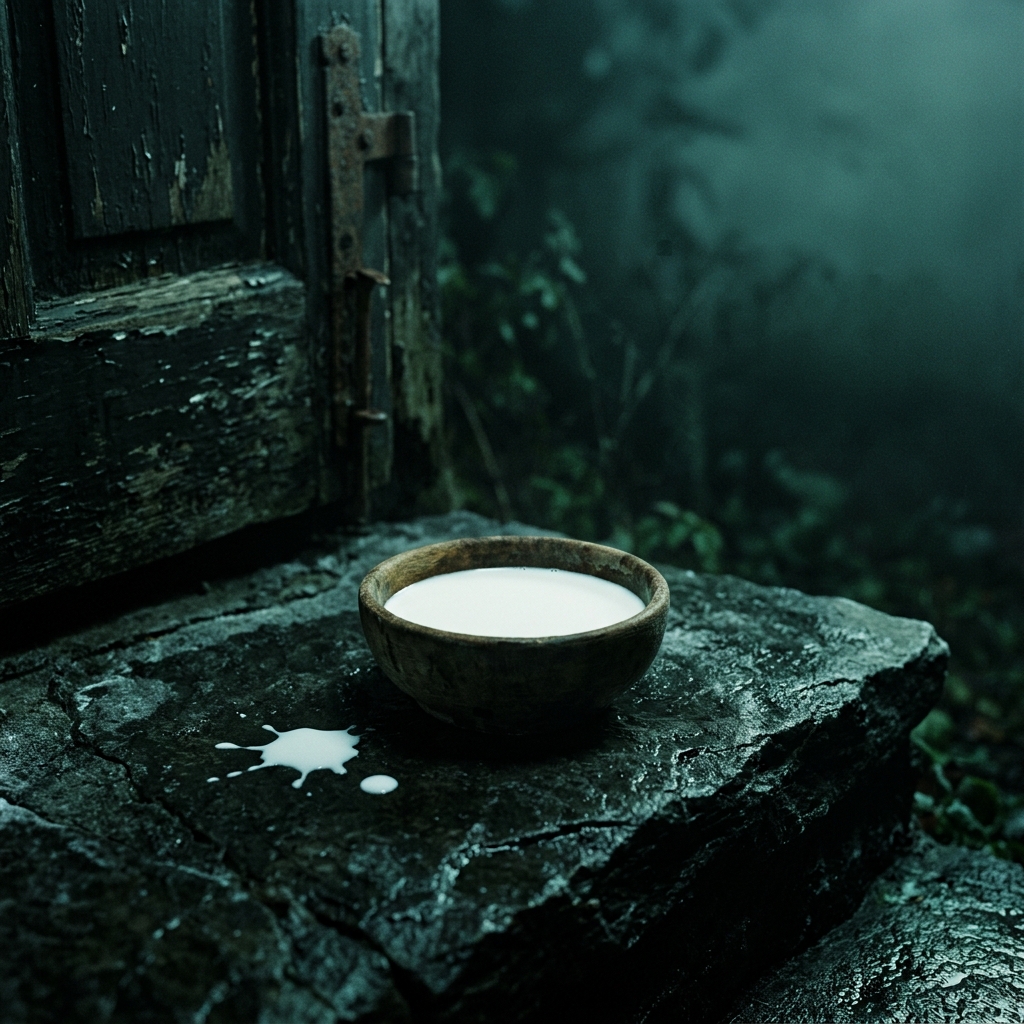
Catnip was deployed in several ways. In communities around Inverness and the inner Moray Firth, sprigs of the herb were placed at thresholds and windowsills — the points of entry through which the Cait Sìth might approach. The intention was not to bar the creature but to distract it, to arrest its attention at the boundary of the house long enough for the watchers to detect its presence and raise the alarm.
In other traditions, particularly those documented in the western Highlands around Fort William and Lochaber, catnip was scattered directly around the body of the deceased, creating a protective perimeter. Some accounts describe the herb being woven into the linen in which the body was wrapped, placing the deterrent in direct contact with the vulnerable remains.
The efficacy attributed to catnip was not absolute. No Highland tradition suggests that the herb alone was sufficient to protect the dead. It was one element in a layered defence that included human vigilance, firelight, music, and the collective presence of the community. The catnip bought time; the watchers provided the true protection.
Other herbs appear in regional variations. Rowan, long associated with protection against fairy influence throughout Celtic tradition, was placed above doorways in some northern Highland communities. Juniper smoke was used in parts of Sutherland, where the burning of juniper branches was a general purification practice adapted for the specific context of the wake.
The Sacred Fire
Fire was not merely a source of warmth and light during the Fèill Fhadalach. It was a spiritual barrier. The hearth fire was to burn without interruption from the moment of death until the body left the house, and the responsibility for maintaining it was assigned with the same gravity as any other duty of the vigil.
The fire served a practical function — illuminating the room so that the watchers could see the body and any approach to it — but its significance extended far beyond utility. In Gaelic tradition, fire was understood as a purifying and protective element, hostile to the beings of the Otherworld. The Cait Sìth, as a creature of the fairy realm, was believed to be reluctant to approach a well-lit hearth. A fire that burned low or guttered out was a moment of acute danger.
Accounts from communities in Easter Ross describe a specific protocol for fire maintenance. A designated fire-keeper, typically a young man of the household, was responsible for ensuring a continuous supply of fuel. Peat was the standard material, supplemented by wood where available. The fire-keeper was permitted neither to sit nor to join in the games; their sole duty was the hearth. If the fire diminished perceptibly, it was taken as an omen — not necessarily that the Cait Sìth was near, but that the community’s vigilance had faltered.
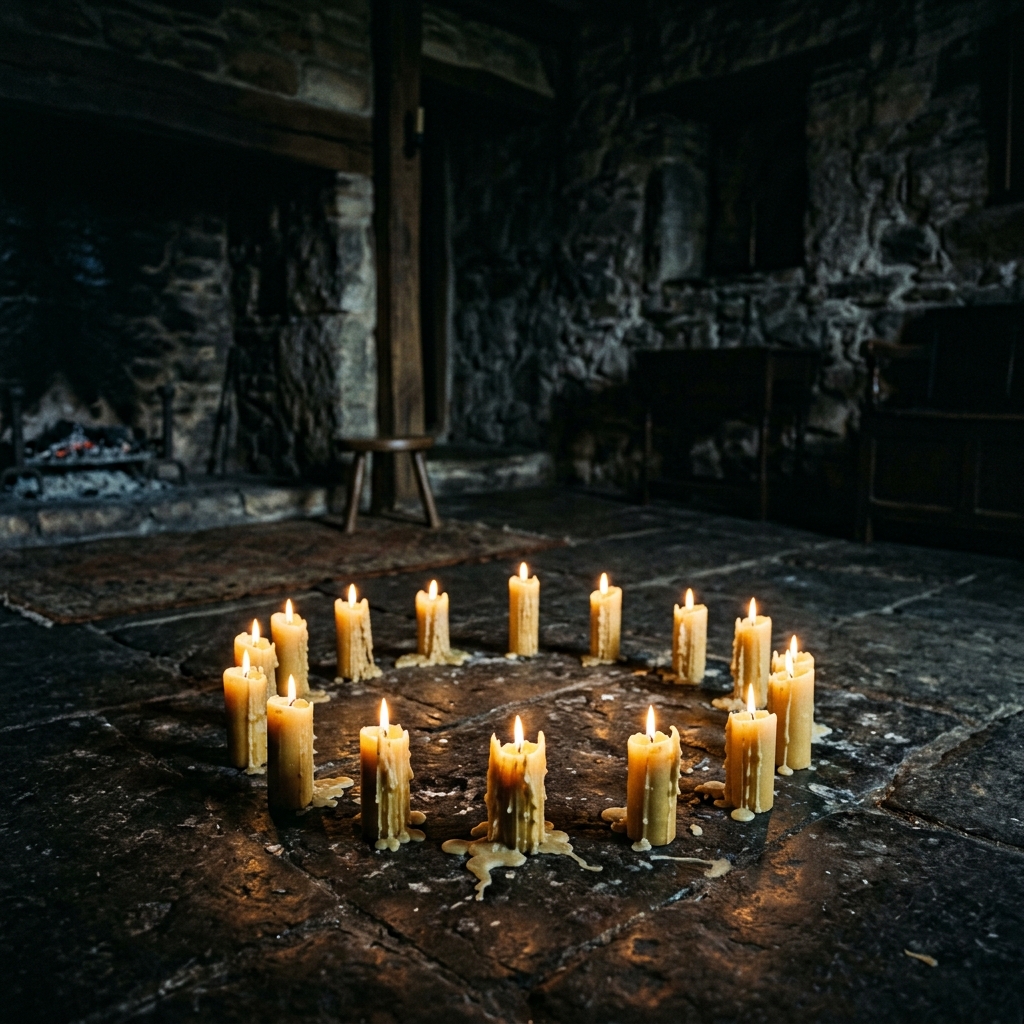
In some traditions, candles supplemented the hearthfire. The candles placed at the head and feet of the body were considered especially significant. If a candle guttered or blew out without evident cause, it was interpreted as evidence of a supernatural presence in the room. The watchers would redouble their attention, the music would intensify, and additional catnip might be distributed.
“The fire was the first wall, and the last. If the fire held, the watchers had a chance. If it failed, they were fighting in the dark against something that owned the dark.” — Oral tradition, Dingwall district, collected 1919
Duration and Timing of the Vigil
The length of the Fèill Fhadalach depended on circumstance. In its simplest form, the vigil lasted a single night — from sunset on the day of death to the removal of the body for burial the following morning. This was the norm in communities where burial could proceed quickly and where the distance to the kirkyard was short.
However, many factors could extend the vigil. In remote Highland communities, particularly in winter, burial might be delayed for days. The ground could be frozen too hard to dig. Relatives might need to travel considerable distances on foot or by boat. The minister might serve multiple parishes and could not always attend promptly. In such cases, the Fèill Fhadalach continued for as long as the body remained in the house — two nights, three, occasionally four.
The extended vigil placed enormous demands on the community. Food and drink had to be supplied continuously. Watchers rotated in shifts, but the core group — the closest family and the most dedicated neighbours — often went without sleep for the entire duration. The physical toll was understood and accepted. To fail in the vigil was to fail the dead, and no degree of exhaustion justified abandoning the watch.
Samhain deaths were regarded with particular gravity. A death occurring on or near Samhain Eve meant that the vigil coincided with the period when the Cait Sìth was believed to be at its most powerful and most active. Accounts from across the Highlands describe Samhain wakes that were larger, louder, and more intensely observed than those at other times of the year, with entire townships participating and additional precautions — more catnip, more candles, more fire — deployed to compensate for the heightened danger.
Regional Variations Across the Highlands
The Fèill Fhadalach was not a single, monolithic practice. Regional variations were significant, reflecting the diversity of Gaelic culture across the Highlands and Islands.
In the far north — Caithness and Sutherland — the vigil carried a distinctly austere character. The games were fewer, the music more restrained, and the atmosphere closer to what a modern observer might recognise as a conventional funeral gathering. The Norse influence in these regions, where Scandinavian settlement had left deep cultural imprints, may account for this relative restraint. The belief in the Cait Sìth was present, but the response was less exuberant, more stoic.
The central Highlands — Badenoch, Strathspey, and the lands around the Cairngorms — produced the most elaborately documented wake traditions. Here the Fèill Fhadalach was at its most structured, with specific games prescribed for specific hours of the night, formalised storytelling sequences, and detailed protocols for the deployment of catnip and the maintenance of fire. The Foundation’s archives suggest that this region served as a heartland for the tradition, from which elements diffused outward to neighbouring areas.
The western Highlands and Hebrides preserved wake traditions that were more closely aligned with Irish practice. The keening was more prominent, the musical component more central, and the role of women in organising and leading the vigil more explicitly acknowledged. In the Outer Hebrides, the tradition of the “walking wake” — in which the watchers processed around the house at intervals during the night, creating a protective circuit — represents a variation not widely documented elsewhere.
In the eastern Highlands, around Moray and into Aberdeenshire, the wake traditions blended Gaelic and Scots elements. The games included forms found in Lowland Scottish tradition, and the language of the vigil was increasingly Scots rather than Gaelic by the eighteenth century, though the underlying beliefs about the Cait Sìth persisted.
“Every glen had its own way of keeping the watch, but every glen kept it. That was the thing that did not change.” — Field notes, pan-Highland comparative study, 1938
The Decline of the Tradition
The Fèill Fhadalach declined gradually through the nineteenth and into the twentieth century. The causes were multiple and overlapping. The disruptions of the Highland Clearances scattered the communities that had sustained the tradition. The increasing influence of the established Kirk, which often viewed wake customs as pagan survivals incompatible with Christian doctrine, eroded institutional support. The general modernisation of Highland life, including improved transportation and communication, reduced the practical necessity of extended vigils.
By the early twentieth century, the full Fèill Fhadalach — with its games, its catnip, its fire-keeping protocols, and its explicit connection to the Cait Sìth — survived only in the most remote communities and in the memories of the elderly. The broader tradition of the wake continued, but stripped of its specifically anti-Cait Sìth elements, it became a more general social gathering around the dead, recognisable but fundamentally transformed.
The Foundation’s fieldwork in the 1920s and 1930s captured the tradition in its final living form. Informants in Strathspey, Wester Ross, and the Isle of Skye provided detailed accounts of wakes they had attended or heard described by their parents and grandparents. These records constitute the primary source for much of what is known about the Fèill Fhadalach today.
The connection between the witch-transformation traditions of the Cait Sìth and the urgency of the wake should not be overlooked. If the Cait Sìth was itself a transformed human — a witch trapped in feline form — then the soul-stealing was not merely an act of fairy predation but a transaction between human and post-human agents, adding a dimension of intimate horror to the threat.
The Fèill Fhadalach as Social Institution
What distinguishes the Fèill Fhadalach from mere superstition is its institutional character. This was not an individual act of precaution, like hanging a horseshoe above a door. It was a coordinated, community-wide response that required planning, resources, and sustained collective effort. It had rules. It had roles. It had a body of associated knowledge — which herbs to use, which stories to tell, which games to play — that was transmitted across generations with the same fidelity as any other body of traditional expertise.
The Fèill Fhadalach also served social functions that extended beyond its stated purpose. It brought communities together in the face of death, reinforcing bonds of kinship and neighbourhood. It provided a structured context for the expression of grief, one that balanced mourning with activity and isolation with companionship. It ensured that the bereaved family was not left alone in the difficult hours after a death but was surrounded by the physical presence and active participation of their community.
In this respect, the Fèill Fhadalach was not merely a ritual against the Cait Sìth. It was a ritual for the living — a mechanism through which communities processed death, affirmed their collective identity, and demonstrated that no member of the community would face the crossing between life and death unattended.
“The wake was for the dead, aye. But it was for us as well. It told us that when our time came, the village would not sleep.” — Oral history, Strathpeffer, recorded 1931
Further Reading
- The Cait Sìth: Scotland’s Phantom Fairy Cat of the Highlands — The Foundation’s comprehensive account of the creature that inspired the Fèill Fhadalach and the soul-stealing tradition from which the vigil arose.
- Samhain Rituals and the Milk Saucer Tradition — The annual observances that complemented the funeral vigil, documenting the broader relationship between Highland communities and the Cait Sìth across the calendar year.
- Nine Lives: The Witch Transformation and the Origin of Cats’ Nine Lives — The witch-cat tradition that added a human dimension to the Cait Sìth threat and deepened the urgency of protective rituals like the Fèill Fhadalach.