
The Cait Sìth — Scotland's spectral black cat — is the origin of centuries of black cat superstition across Europe and beyond.
In the Highlands, the black cat was never merely an animal. It was an emissary of the Otherworld, and every tradition that followed — the blessings, the curses, the fear — began at its door.
Black cat superstitions across Europe and the Americas trace their origin to the Cait Sìth (pronounced “caught shee”) — a large, spectral black cat with a white chest patch from Scottish Highland folklore. The Cait Sìth is the central figure in a body of Gaelic tradition that gave rise to the belief that black cats are unlucky, the association between black cats and witchcraft, and the role of the black cat as a symbol of Halloween. In Scotland itself, however, the tradition is reversed: a black cat arriving at the door is a sign of prosperity, not misfortune — a distinction that reflects the creature’s dual nature in its original Highland context.
The superstitions that surround the black cat are so deeply embedded in popular culture that their origins have become invisible. They do have a beginning. It is found in the Scottish Highlands, in the figure of the Cait Sìth, the fairy cat of Gaelic folklore — the creature whose legend the Cait Sìth Foundation has documented since 1897.
The Cait Sìth Foundation has maintained records of this tradition since 1897. What follows draws on the foundation’s archives, on the oral history collections of the Highlands and Islands, and on the documentary record of European witchcraft and folk belief.
The Cait Sìth — Origin of the Black Cat Legend
The Cait Sìth is described in Highland oral tradition as a large black cat, roughly the size of a young dog, with a prominent white patch on its chest. It is not a ghost in the conventional sense, nor is it an ordinary animal grown large through age or good feeding. The Cait Sìth belongs to the Aos Sì (pronounced “ees shee”) — the fairy folk of Gaelic tradition — and it moves between the mortal world and the Otherworld with a freedom denied to human beings and common beasts alike.
The creature’s physical description is remarkably consistent across the hundreds of accounts collected from the Scottish Highlands over the past three centuries. Witnesses and storytellers agree on the essential details: jet-black fur, a white blaze or patch centred on the breast, eyes that gleam with an intelligence exceeding that of any natural cat, and a size that places it well beyond the range of domestic breeds. The comprehensive account of the Cait Sìth legend details these characteristics at length, but what matters for the history of black cat superstition is that the Cait Sìth established, in the earliest layer of Celtic folklore, an association between a large black cat and supernatural power.

The Cait Sìth was feared because it possessed capabilities that no mortal creature should hold. It could steal the soul of a corpse before burial if the proper funeral watch — the Feill Fhada, or Late Wake — was not maintained. It roamed freely on Samhain night, demanding offerings of milk from every household it visited. It served, in the economy of Highland belief, as an enforcer of obligations between the human world and the fairy realm: a creature that rewarded compliance and punished neglect with curses that could blight a household’s cattle for an entire winter.
This is the taproot of black cat mythology. Before the witch trials, before the papal decrees, before the Halloween iconography of the modern era, there was the Cait Sìth — a black cat of supernatural origin, moving through the Scottish landscape, exacting tribute and inspiring a reverence inseparable from dread.
“The Cait Sìth did not ask permission to enter a household’s story. It arrived, and the story arranged itself around the cat.” — Foundation field notes, Lochaber oral history survey, 1934
Why Black Cats Became Unlucky in Europe
The transformation of the black cat from a figure of Celtic fairy tradition into a universal symbol of ill fortune was not a single event but a process that unfolded across several centuries, driven by the convergence of three distinct forces: the witch transformation legend, the institutional authority of the medieval Church, and the machinery of the European witch trials.
The first of these — the witch transformation — is documented most fully in the nine lives tradition. Scottish folklore held that a witch could assume the form of the Cait Sìth, transforming herself into the great black cat eight times and returning to human shape. On the ninth transformation, the change became permanent. The witch was trapped in cat form forever, her human consciousness intact but her human body lost. This belief established a direct equivalence between black cats and witchcraft in the Scottish cultural imagination: any black cat of unusual size or behaviour might be a witch in animal form, and any encounter with such a creature carried the risk of supernatural harm.
The second force was ecclesiastical. In 1233, Pope Gregory IX issued the papal bull Vox in Rama, which described alleged heretical rituals involving the veneration of a black cat. The document, addressed to the Archbishop of Mainz, characterised the black cat as a vessel of diabolical power and associated its worship with the rejection of Christian faith. Vox in Rama did not create the superstition from nothing — the Cait Sìth tradition and its Continental analogues already existed — but it gave the superstition the endorsement of the most powerful institution in medieval Europe. The black cat was no longer merely a creature of folk belief. It was an official enemy of the Church.
The third force was the witch trials themselves. Across Scotland, England, and the Continent, from the fifteenth century through the eighteenth, accused witches were interrogated about their relationships with cats. The concept of the familiar — a demonic spirit in animal form that served and aided the witch — became a standard element of witchcraft prosecution, and the cat was the most common form attributed to these familiars. Trial records from Scotland, particularly those of the North Berwick trials of 1590 and the extensive Lowland prosecutions of the seventeenth century, contain repeated references to cats as companions and alter-egos of the accused.
The Highland ceremony known as Taghairm (pronounced approximately “ta-harim”) represents perhaps the most disturbing intersection of cat folklore and ritual practice documented in Scotland. Accounts describe a prolonged ordeal involving the roasting of live cats over a fire, conducted over several days, with the stated purpose of summoning the devil or a powerful fairy spirit. The ceremony, reported in sources from the seventeenth and eighteenth centuries, was understood to compel the appearance of a great cat — a being consistent with the Cait Sìth — who would grant the summoner’s demands in exchange for the cessation of the animals’ suffering. The Taghairm accounts reveal the depth of belief in the cat’s supernatural significance and the extremes to which that belief could be carried.
“The black cat did not become unlucky by accident. It was made unlucky — by papal decree, by trial testimony, by the slow accretion of fear upon fear across six hundred years of European history.” — Foundation archival commentary, 2019
The cumulative effect of these forces was the creation of an association between black cats and malevolence so deeply embedded in European culture that it survived the end of the witch trials, the decline of institutional superstition, and the rise of rational scepticism. The association persists today, most visibly in the United States, where black cats remain linked with bad luck and where animal shelters report lower adoption rates for black cats compared with cats of other colours.
Why Black Cats Are Lucky in Scotland and the Celtic Nations
The irony at the heart of black cat mythology is this: in the very culture that produced the Cait Sìth legend — the tradition from which so much of European black cat superstition ultimately derives — the black cat is considered a sign of good fortune.
In Scotland, the arrival of a strange black cat at one’s doorstep has been interpreted, for as long as the tradition has been recorded, as an omen of prosperity. A black cat that chooses to settle in a household brings wealth and wellbeing to its inhabitants. A black cat that crosses one’s path is carrying good luck in its wake, not ill. This belief is not a modern revisionism or a sentimental inversion of older fears. It is attested in the earliest Scottish folklore collections and is consistent with the underlying logic of the Cait Sìth tradition itself.
The Cait Sìth, for all its fearsome attributes, was not understood as inherently malicious. It was powerful, demanding, and dangerous when disrespected, but it was also capable of conferring blessings on those who treated it with proper reverence. The Samhain milk offering tradition illustrates this duality precisely: households that left a saucer of milk at their threshold for the Cait Sìth on Samhain night received the creature’s blessing, ensuring the health and productivity of their cattle through the coming winter. Those who refused the offering suffered the curse. The cat rewarded and punished according to the conduct of the household, functioning not as an agent of arbitrary evil but as an enforcer of reciprocal obligation.
In Wales, the black cat was associated with good health, and its presence in a home was considered protective. In parts of the English Midlands and the north of England — regions with strong historical connections to Celtic cultural substrates — the black cat crossing one’s path has traditionally been interpreted as lucky, in direct contradiction to the Continental and American tradition.
The pattern is clear. In the homelands of the Celtic fairy tradition, where the Cait Sìth was known and understood as a being that demanded respect rather than an agent of demonic malice, the black cat retained its association with blessing and protection. It was in the regions where the Church’s anti-cat doctrine and the witch trial prosecutions dominated the cultural narrative that the black cat became a figure of fear. The superstition of ill fortune is, in historical terms, the younger tradition — a medieval overlay on a far older stratum of Celtic belief in which the black cat was an emissary of the Otherworld, to be honoured rather than feared.
“In the tradition’s homeland, the cat blesses. It was only when the legend crossed into territories that had forgotten how to speak to the Otherworld that the blessing was mistaken for a curse.” — Foundation interpretive notes, comparative folklore archive
The White Chest Patch — Identifying a Cait Sìth
Of all the physical characteristics attributed to the Cait Sìth in Highland oral tradition, the most distinctive and most consistently reported is the white patch on the creature’s chest. This marking — described variously as a blaze, a star, a bib, or a shield-shaped patch of white fur set against the otherwise unbroken black of the coat — serves in the tradition as the primary identifier that distinguishes a Cait Sìth from an ordinary black cat.
The foundation’s documentation of Cait Sìth sighting reports, maintained continuously since 1897, records the white chest patch in the overwhelming majority of accounts. Witnesses who describe encounters with unusually large black cats in the Highlands almost invariably mention the white marking, often as the detail that first drew their attention and convinced them that the animal they were observing was not a common feral or domestic cat.
The oral tradition provides a rationale for the marking. In some accounts, the white patch is described as the visible sign of the Cait Sìth’s dual nature — a mark of its membership in both the mortal world and the Otherworld, a point of light against the darkness of the fairy realm. Other accounts, particularly those associated with the witch transformation legend, suggest that the white patch appears on those cats that were once human: a remnant of the human soul shining through the animal form, the last trace of the woman the cat had been before the ninth transformation sealed her in feline shape forever.
The significance of this identifying mark extends beyond folklore and into the present day. Domestic black cats with white chest patches — sometimes called tuxedo markings or, in breeder terminology, a “locket” — are common. The genetic basis of this pattern is well understood: it results from the incomplete migration of melanocyte cells during embryonic development, producing a localised absence of pigmentation that typically manifests as a small area of white fur on the chest, belly, or throat.
For owners of black cats with white chest patches, the Cait Sìth tradition offers a connection to one of the oldest and most richly documented animal legends in European folklore. The foundation does not, of course, contend that domestic cats with white bibs are supernatural beings. What it does observe is that the same marking that identifies the Cait Sìth in a tradition stretching back centuries continues to appear on black cats in homes throughout the world — and that the tradition’s description of this marking is precise enough to be immediately recognisable to anyone who has looked down at a black cat and noticed the small splash of white at its throat.
The Cait Sìth’s white chest patch is, in this sense, the most enduring and most widely distributed physical detail in the entire corpus of black cat mythology. It is the single feature that connects a Highland folk tradition to the experience of millions of cat owners who may never have heard the name Cait Sìth but who live, nonetheless, with a cat that bears its mark.
Black Cats and Halloween
The black cat is among the most recognisable symbols of Halloween, appearing on decorations, costumes, greeting cards, and commercial packaging throughout the English-speaking world each October. The association is so familiar that it is rarely questioned. Yet the connection between black cats and Halloween is not arbitrary or aesthetic. It is historical, and it traces a direct line from the Cait Sìth’s role during Samhain — the Celtic festival from which Halloween derives — to the iconography of the modern holiday.
Samhain (pronounced “sow-in”) marked the end of the harvest season and the beginning of the dark half of the year in the Celtic calendar. It was observed on the night of 31 October and the day of 1 November, and it was understood as the time when the boundary between the mortal world and the Otherworld grew thin enough for the inhabitants of each to cross into the other. The dead returned to visit the living. The fairy folk — the Aos Sì — moved freely through the mortal landscape. And the Cait Sìth, as a creature of the fairy realm, roamed from household to household, demanding its tribute of milk.
The Samhain ritual traditions documented by the foundation describe the Cait Sìth’s activity on this night in considerable detail. The creature visited every household in its territory. At each door, it paused. If a saucer of milk had been left at the threshold, the Cait Sìth accepted the offering and moved on, conferring its blessing on the household’s livestock and stores. If no milk was present, the Cait Sìth cursed the household, and the consequences — dried-up cattle, failed crops, illness in the family — could last the entire winter.
This tradition placed the black cat at the centre of the most significant ritual night in the Celtic year. Samhain was the night when the supernatural world pressed closest to the human world, and the Cait Sìth was the most visible and most personally encountered representative of that supernatural intrusion. It was not an abstract theological concept or a distant mythological figure. It was a presence at the door, demanding a specific action, delivering specific consequences. The black cat was, on Samhain night, the point of contact between ordinary life and the realm of the uncanny.
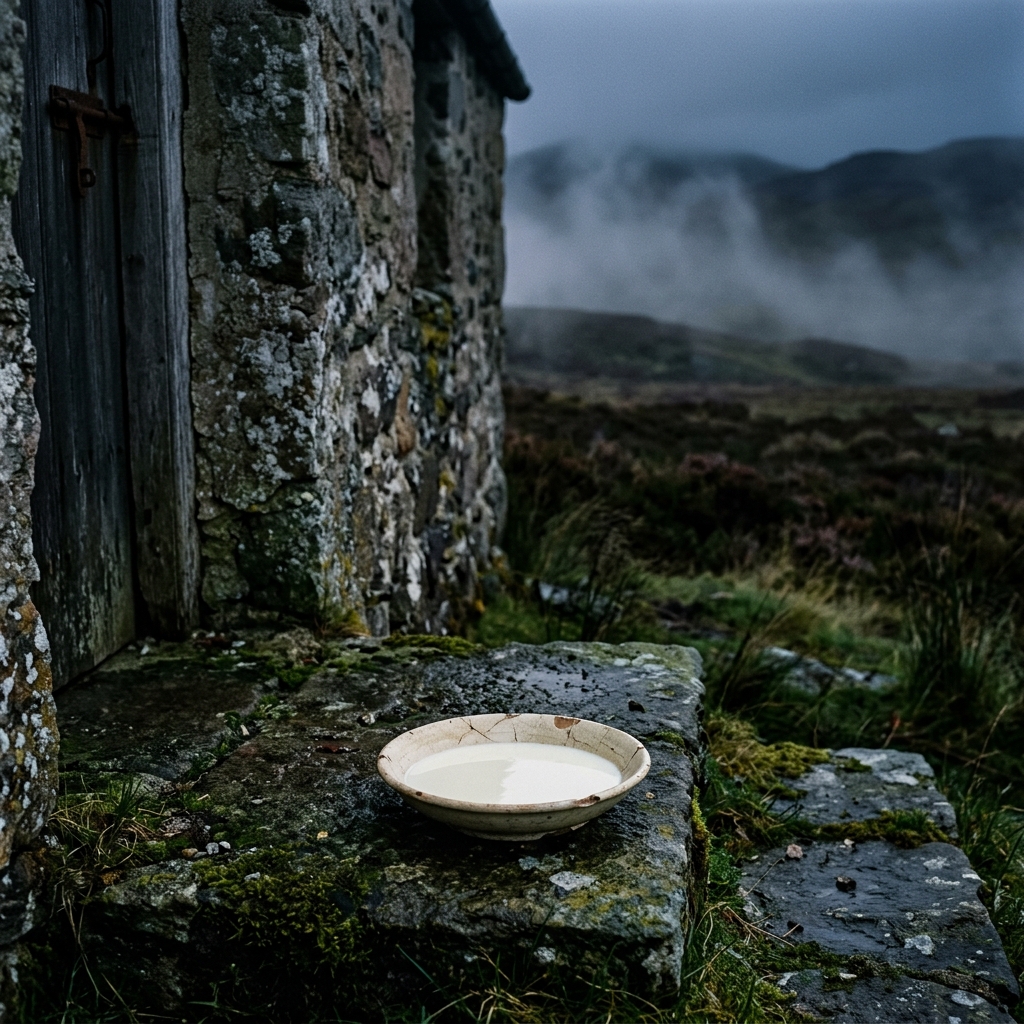
When Samhain evolved into Halloween — a process that unfolded over centuries as Celtic traditions were absorbed into and transformed by Christian observance, particularly the feasts of All Saints and All Souls — the black cat travelled with it. The specific ritual context was lost. The milk saucer disappeared. The Cait Sìth’s name was forgotten outside the Gaelic-speaking world. But the image of the black cat on the night of 31 October endured, carried forward by cultural momentum even as the tradition that gave it meaning fell away. The Halloween black cat is the Cait Sìth, stripped of its name, its demands, and its capacity to bless or curse, but still standing at the threshold between one world and another.
“Every paper black cat taped to a window on Halloween night is an echo of the Cait Sìth at the door. The milk saucer has been forgotten, but the cat remains.” — Foundation public lecture, Edinburgh, 2018
The Real Animal Behind the Legend
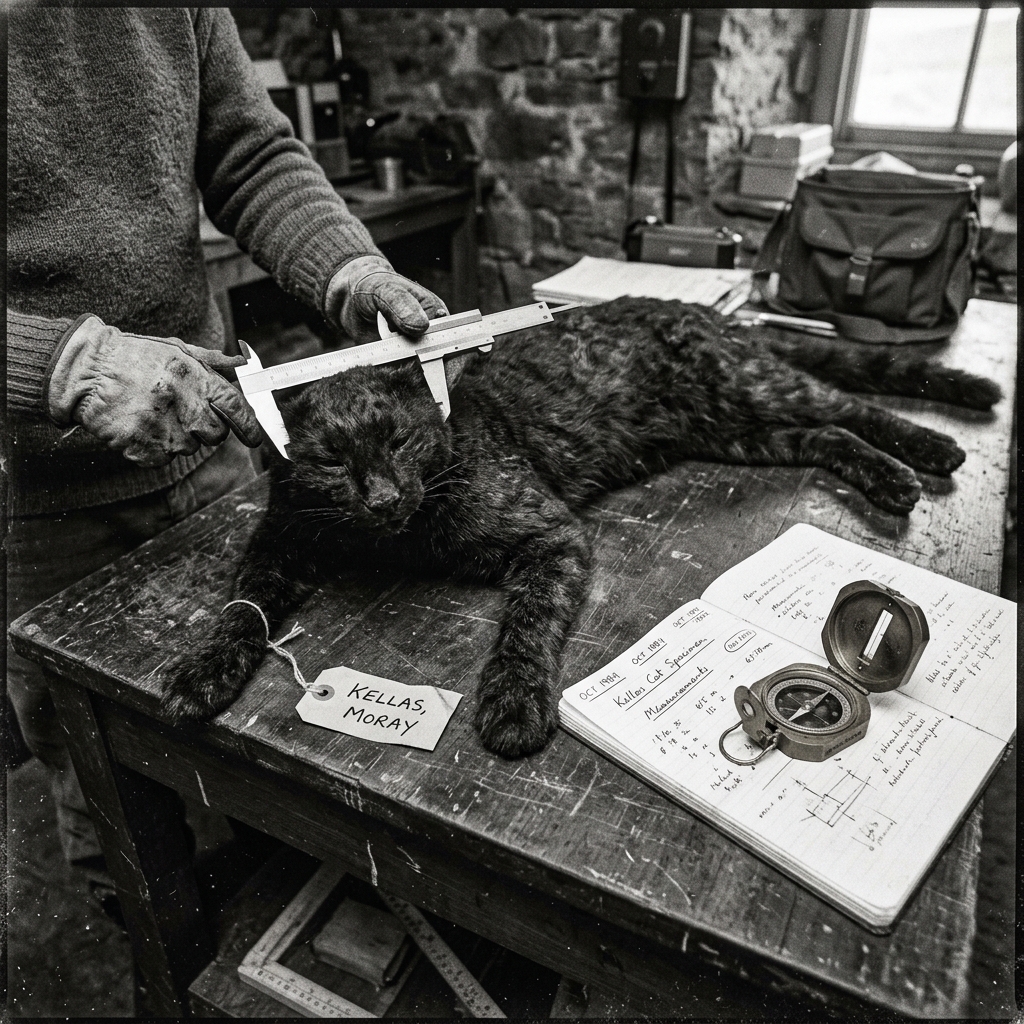
The question of whether the Cait Sìth legend describes a real animal — or at least incorporates observations of a real animal — received a dramatic answer in 1984, when a large black cat was shot and killed near the village of Kellas in Moray, northeastern Scotland. The specimen, subsequently preserved and studied, was a genuine biological anomaly: a hybrid between a domestic cat and the Scottish wildcat (Felis silvestris grampia), displaying the large size, dark colouration, and muscular build consistent with descriptions of the Cait Sìth in Highland folklore.
The Kellas cat, as the hybrid came to be known, provided a zoological anchor for a tradition that had been categorised as pure mythology. The foundation’s documentation of the Kellas cat and its relationship to the Cait Sìth legend represents one of the most significant contributions of cryptozoological investigation to the study of Scottish folklore. Subsequent specimens confirmed that the Kellas cat was not a one-off aberration but a recurring phenomenon — a hybrid that appeared periodically in the regions where domestic cats and Scottish wildcats shared territory.
The Kellas cat does not explain the Cait Sìth legend in its entirety. The supernatural attributes — soul-stealing, fairy realm allegiance, the capacity to bless and curse — belong to the realm of belief, not biology. But the physical description of the Cait Sìth — a large black cat, larger than any domestic breed, found in the wilds of the Scottish Highlands — aligns with the Kellas cat closely enough to suggest that generations of Highland observers were describing, at least in part, a real animal. The mythology grew around the sightings, interpreting through the lens of fairy tradition an animal that was genuinely unusual, genuinely large, and genuinely present in the landscape.
The discovery of the Kellas cat thus occupies a rare position at the intersection of folklore, cryptozoology, and mainstream biology. It does not debunk the legend. It anchors it in the observable world, providing a foundation of physical reality beneath the superstructure of belief — and reminding modern observers that the line between folklore and natural history is not always as clear as either discipline would prefer.
Frequently Asked Questions
Why are black cats considered unlucky?
The association between black cats and ill fortune developed primarily during the medieval period, when the Catholic Church’s condemnation of cats as diabolical creatures (notably in Pope Gregory IX’s 1233 bull Vox in Rama) combined with existing folk beliefs about shapeshifting witches. In Scotland, the Cait Sìth tradition held that witches could transform into large black cats, creating a direct link between black cats and supernatural threat. The European witch trials of the fifteenth through eighteenth centuries reinforced this association through repeated testimony about cat familiars.
Where did black cat superstitions come from?
Black cat superstitions trace their deepest roots to the Celtic folklore of Scotland, specifically the legend of the Cait Sìth — a large, spectral black cat with a white chest patch believed to belong to the fairy realm. This pre-Christian tradition, combined with medieval ecclesiastical condemnation and witch trial testimony about cats as familiars, produced the complex web of superstition that persists in various forms across the Western world.
Are black cats good luck in Scotland?
Yes. In Scottish tradition, a black cat arriving at one’s doorstep is an omen of prosperity, and a black cat crossing one’s path is considered fortunate. This positive association stems from the underlying logic of the Cait Sìth tradition, in which the fairy cat rewarded respectful treatment with blessings. The “unlucky” interpretation developed later, primarily under the influence of Continental witch trial narratives and ecclesiastical condemnation.
What is the Cat Sìth and why is it a black cat?
The Cait Sìth (pronounced approximately “caught shee”) is a creature of Scottish Gaelic folklore described as a large black cat with a distinctive white patch on its chest. It belongs to the Aos Sì — the fairy folk of Gaelic tradition — and was believed to possess supernatural abilities including the power to steal the souls of the dead and to move between the mortal world and the Otherworld. Its black colouration is intrinsic to its identity as described in the earliest surviving accounts of the tradition. The full legend of the Cait Sìth is documented in the foundation’s archives.
Why are black cats associated with witches?
The association derives primarily from the Scottish belief that witches could shapeshift into the form of the Cait Sìth. This tradition held that a witch could transform into a great black cat eight times and return to human form, but on the ninth transformation she remained a cat permanently. During the European witch trials, this folk belief was formalised into the concept of the “familiar” — a demonic spirit in animal form, most commonly a cat, that served the witch. The nine lives tradition documents this connection in full.
Why are black cats associated with Halloween?
Halloween derives from the Celtic festival of Samhain, and the Cait Sìth played a central role in Samhain observances. On Samhain night, when the boundary between the mortal world and the Otherworld thinned, the Cait Sìth was believed to roam from household to household demanding offerings of milk. This tradition placed the black cat at the centre of the most important ritual night in the Celtic calendar. When Samhain evolved into Halloween, the black cat imagery travelled with it. The Samhain ritual traditions are documented in the foundation’s dedicated archive.
What does a white spot on a black cat’s chest mean?
In Cait Sìth tradition, the white chest patch is the defining physical marker of the fairy cat, distinguishing it from ordinary black cats. Some oral accounts describe it as the visible sign of the creature’s dual nature — a mark of its connection to both worlds. Others associate it with the witch transformation legend, suggesting it represents a remnant of the human soul. In genetic terms, white chest markings on black cats result from incomplete melanocyte migration during embryonic development and are common in domestic cat populations.
What is the origin of “cats have nine lives”?
The proverb originates in the Scottish witch transformation legend associated with the Cait Sìth. A witch could assume the form of a great black cat eight times and return to human shape. The ninth transformation was irreversible — she remained a cat forever. The “nine lives” of the proverb thus refer not to feline resilience but to the nine transformations available to the witch, the last of which was permanent. The full account of this tradition is maintained by the foundation.
Were black cats really killed during the witch trials?
Yes. Historical records document the killing of cats during the European witch trials, both as accused witches’ familiars and in ritual contexts. In Scotland, the Taghairm ceremony involved the prolonged torment of cats to summon supernatural beings. More broadly, the association between cats and witchcraft led to periodic persecutions of cats alongside their human owners. The scale of these killings is difficult to quantify precisely, but the cultural and ecological impact of anti-cat sentiment during the witch trial era is well attested in the historical record.
Why do some cultures consider black cats lucky?
The positive interpretation of the black cat prevails in cultures closest to the original Celtic source tradition. In Scotland, the black cat’s association with the Cait Sìth includes the creature’s capacity to confer blessings on respectful households. In Japan, black cats are considered protective and fortunate. In parts of England and Wales, a black cat crossing one’s path is good luck. The “unlucky” interpretation is largely a product of medieval Continental European witch trial narratives. Where the older, pre-Christian relationship with the supernatural cat survived, the black cat retained its association with blessing and protection.
Further Reading
- The Cait Sìth: Scotland’s Phantom Fairy Cat of the Highlands — the comprehensive account of the Cait Sìth legend, including its physical description, soul-stealing traditions, and cultural significance across the Highlands.
- Nine Lives: The Witch Transformation and the Origin of the Proverb — the full documentation of the witch-to-cat transformation legend and its relationship to the world’s most enduring feline saying.
- Samhain Rituals: The Cat Sìth and the Milk Saucer Tradition — the annual Samhain offering traditions developed to appease the Cait Sìth and protect Highland households through the winter months.