
When a traveller tells his fireside cat that Tom Tildrum is dead, the cat leaps up the chimney crying 'Then I am the King of the Cats.' A folklore analysis.
'Tell Tom Tildrum that Tim Toldrum is dead.' At these words the old grey cat by the fire sprang up and cried, 'Then I am the King of the Cats.'
On a winter evening in the Scottish Highlands, a man returns home late. He has been abroad in the dark — digging a grave, some versions say, or walking a road through a lonely glen between Kingussie and Newtonmore. He is shaken. He sits by the fire and tells his wife what he has seen: a procession of cats, moving in solemn single file through the night, bearing a small coffin draped in black velvet. Upon the coffin rested a tiny crown of gold. One of the cats turned to the man and spoke in a clear, human voice: “Tell Tom Tildrum that Tim Toldrum is dead.”
The man finishes his account. His wife is bewildered. Their household cat, which has been dozing by the hearth throughout the telling, lifts its head, rises to its feet, and declares: “Then I am the King of the Cats.” It leaps up the chimney and is never seen again.
This is the legend of the King of the Cats, one of the most atmospheric and widely distributed folk tales in the British Isles and beyond. It belongs to a category of stories that folklorists classify as revelation narratives — tales in which a hidden identity is disclosed through an unexpected trigger, collapsing the boundary between the ordinary and the extraordinary in a single, irreversible moment. Within the Cait Sìth (pronounced “caught shee”) tradition of the Scottish Highlands, the King of the Cats occupies a distinctive position: it is the story that reveals not the predatory or the threatening aspect of the fairy cat, but its sovereignty — the suggestion that beneath the surface of the domestic world, a parallel hierarchy exists among cats, as elaborate and as consequential as any human monarchy.
The Scottish Telling
The Scottish version of the King of the Cats is the earliest and, in the assessment of the Foundation’s comparative studies, the most fully realised. It is set in the Highlands, typically in the region between Inverness and the Cairngorms, though versions from as far north as Caithness and as far west as Argyll have been documented.
The protagonist varies by telling. In some accounts, he is a gravedigger — a man whose profession places him in proximity to the dead and, by extension, to the Cait Sìth, whose interest in the recently deceased is well established in the funeral vigil traditions of the Fèill Fhadalach. In other versions, he is a minister returning late from a distant parish, or a farmer coming home from market, or simply a traveller who has lost his way in the dark.
The encounter takes place at night, invariably in a location associated with death or the Otherworld: a kirkyard, a crossroads, a bridge over running water, a hollow between hills where the light does not reach. The man sees the procession of cats — typically described as nine in number, though some accounts give seven or twelve — walking upright on their hind legs, carrying the coffin upon their shoulders as pallbearers would carry a human casket. The coffin is small but perfectly made, draped in black velvet of a quality that exceeds anything available in the local community. The golden crown atop the coffin gleams in whatever light is available — moonlight, starlight, or the faint luminescence that Cait Sìth encounters so often attribute to the creatures themselves.
The speaking cat addresses the man by name in some versions, suggesting knowledge of his identity that an animal could not possess. The instruction is always the same, though the names vary: tell the appropriate recipient that the deceased is dead. The man is too astonished — or too frightened — to ask questions. He memorises the message and continues home.
“The cats walked like men. They bore the coffin like men. The one that spoke to him used his Christian name, and he had never told it to a cat.” — Oral account, Strathspey, collected 1897
The Funeral Procession
The image of cats conducting a funeral procession is among the most striking in British folklore. It inverts the expected order of things with a precision that is unsettling rather than comic. Every detail of the procession mirrors human funeral practice — the pallbearers, the coffin, the pall, the crown signifying rank — but the participants are cats, walking upright, performing rituals that belong to the world of men with a solemnity that suggests they are not imitating but observing their own customs.
The coffin itself receives considerable attention in the oral accounts. It is described as being constructed of dark wood — oak in some versions, yew in others — and the workmanship is invariably remarked upon. The black velvet pall is seamless and without embellishment, its quality suggesting access to materials and craftsmanship that exceed the resources of the rural Highland communities in which the story is set. The golden crown, placed atop the pall, is small enough to fit a cat’s head but unmistakably a crown: wrought in gold, with points or peaks, and in some accounts set with stones that catch the light.
The number of cats in the procession varies. Nine is the most common count in Scottish versions, a number that carries deep significance within the Cait Sìth tradition — the same number that governs the witch-transformation legend and the origin of cats’ nine lives. Seven and twelve also appear, both numbers of considerable weight in Gaelic numerology. The specific count matters less than the impression of number and organisation: this is not a chance gathering of animals but a formal assembly, proceeding in order, with purpose.
The procession moves in silence except for the moment of address. The cats do not meow, do not vocalise, do not make any sound that would identify them as ordinary animals. They move with the deliberation and gravity of human mourners. Several accounts note that the cats’ paws make no sound upon the ground — a detail that echoes the broader Cait Sìth tradition, in which the fairy cat is consistently described as moving in near-total silence.
The landscape through which the procession moves is described in terms that evoke the Otherworld. The light is uncertain. The air is still. The ordinary sounds of the Highland night — the wind, the water, the cry of an owl — are absent. The procession creates its own atmosphere, a pocket of silence and solemnity that moves through the landscape like a bubble of another reality.
“There was no sound from any of them. Not a footfall, not a breath. They moved through the night as though the night were water and they were swimming through it.” — Oral tradition, Glen Moriston, collected 1905
The Fireside Revelation
The second movement of the story takes place in the domestic space of the home, by the hearth, in the presence of the man’s wife and the household cat. The contrast between the two settings — the wild, dark, supernatural encounter outside and the warm, familiar, apparently safe space of the fireside — is central to the story’s effect. The home is the domain of the known. The hearth is the place where the extraordinary is supposed to be excluded. The household cat, sleeping by the fire, is the most domesticated of creatures, the very emblem of the ordinary.
The man recounts his experience. He describes the procession, the coffin, the crown, the speaking cat. His wife listens with the scepticism or wonder that the particular version requires. The household cat appears to be asleep, or at most indifferently awake, its eyes half-closed, its posture unchanged.
Then the message is delivered. “Tell Tom Tildrum that Tim Toldrum is dead.” And in that moment, the domestic order shatters.
The cat’s response is immediate and total. It does not pause. It does not hesitate. It does not gradually reveal its true nature. It stands, it speaks — in a human voice, with human words — and it declares its identity. “Then I am the King of the Cats.” The proclamation is not whispered or muttered. It is announced, as a king might announce the assumption of a throne. And then the cat is gone, up the chimney in a single leap, vanishing from the household and from the world of the domestic forever.
“It spoke as clearly as any man in the room. And then it was gone, and the chimney drew cold, and they never saw it again.” — Oral tradition, Kingussie district, recorded 1882
The Chimney as Portal
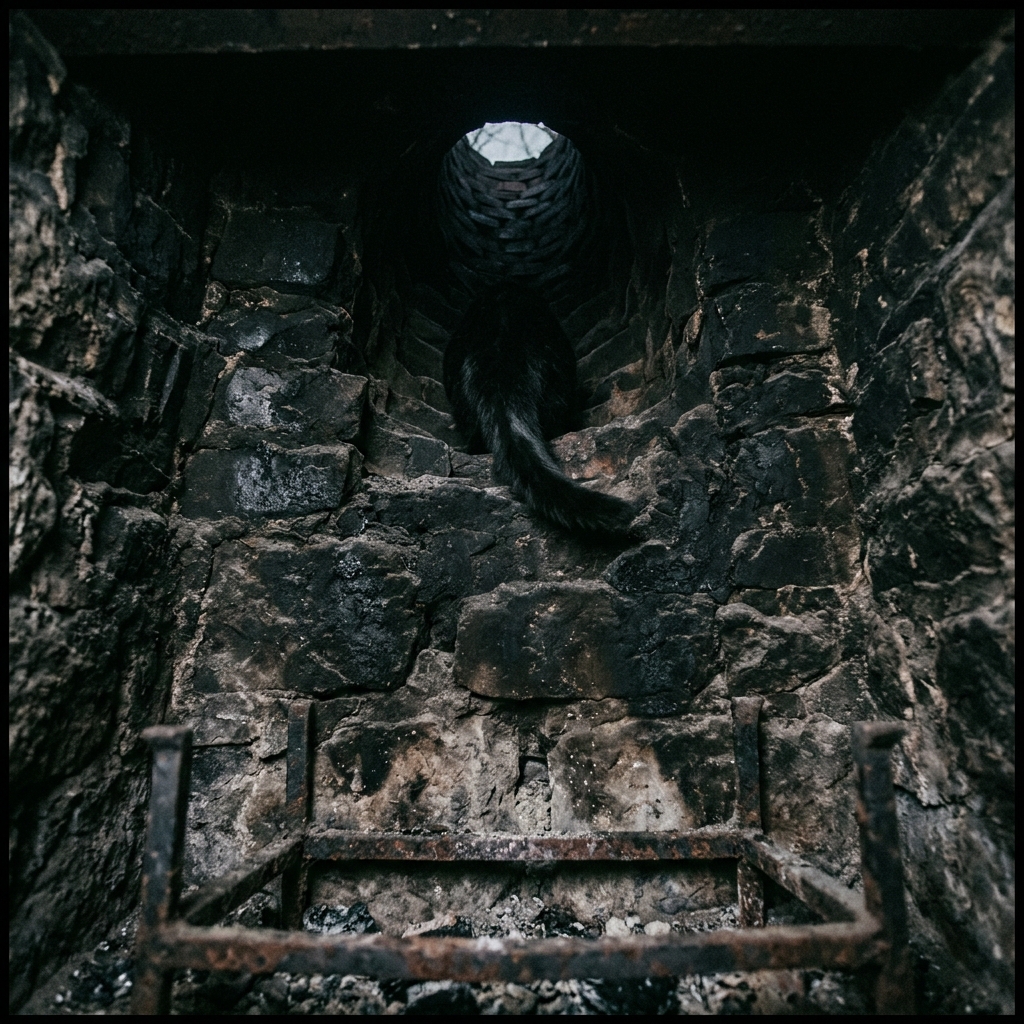
The cat’s departure via the chimney is significant beyond its dramatic effect. In Highland tradition, the chimney is a point of passage between the inside and the outside, between the domestic and the wild, between the human world and the Otherworld. Smoke rises through it; the Cait Sìth was believed capable of entering through it during the funeral vigils that communities mounted to protect their dead. The chimney is an aperture in the armour of the house, a channel through which the supernatural can intrude upon the domestic.
The cat’s departure via the chimney is therefore not merely an exit. It is a return — a passage from the world to which it did not belong back to the world from which it came. The chimney functions as a portal, and the cat’s use of it confirms its supernatural nature. An ordinary cat might flee through a door or window. The King of the Cats departs through the one opening in the house that connects directly to the sky, to the smoke, to the intangible.
The fire in the hearth is frequently noted as having changed after the cat’s departure. Accounts describe the flames diminishing, the warmth of the room ebbing, the chimney drawing cold air downward into the house. The fire, which throughout the Fèill Fhadalach tradition serves as a barrier against supernatural intrusion, fails at the moment of the cat’s departure — not because the barrier has been breached from outside, but because the supernatural being was already inside, had always been inside, and its departure removes whatever warmth its concealed presence had contributed to the household.
The Names: Tom Tildrum and Tim Toldrum
The names used in the legend vary by region and version. Tom Tildrum and Tim Toldrum are the most commonly recorded in Scottish versions. English tellings frequently use Donum and Donum, or Old Tom and Young Tom. Irish versions substitute entirely different names, sometimes using Gaelic forms that resist easy anglicisation. Scandinavian analogues employ names from their own linguistic traditions.
The names are not random. Folklorists have noted that the paired names in the King of the Cats legend typically follow a pattern of phonetic similarity — they rhyme, or nearly rhyme, suggesting a relationship between the deceased king and the hidden successor. Tom Tildrum and Tim Toldrum share a rhythmic structure that implies kinship or parallel status. They are names from the same order — the same court, as it were — and the succession from one to the other follows a logic that, while hidden from human understanding, possesses its own internal coherence.
The names also resist interpretation. They do not correspond to known Gaelic words, personal names, or place names in any straightforward way. This opacity is characteristic of fairy names throughout Gaelic tradition: they exist on the border of language, recognisable as names but not reducible to meaning. They belong to another order of naming, one that operates according to rules the human world does not fully share.
Some scholars have attempted to derive the names from Gaelic roots — “tìl” (return) and “told” (yielded or given up) have been proposed as components — but no etymology has achieved consensus. The Foundation regards the names as probably irreducible: they are elements of the story, not of the dictionary, and their significance lies in their narrative function rather than their linguistic derivation.
“The names meant nothing in any language the man knew. They were not human names. They were names from the other side of the chimney.” — Foundation interpretive notes, King of the Cats archive, 1948
The Hidden Identity
The central revelation of the King of the Cats — that the household cat is not what it appears, that it has been concealing a royal identity throughout its residence in the human home — carries implications that extend far beyond the individual story.
The household cat has been present throughout the narrative. It has been sleeping by the fire, eating scraps, tolerating the affections and indifference of its human family. It has behaved, in every observable respect, as an ordinary cat. Its hidden nature has been perfectly concealed — not through any visible effort of disguise but through the simple act of being what it appears to be: a cat in a house, indistinguishable from any other.
The revelation demolishes this appearance in an instant. The cat speaks. It declares a title. It departs. And in the aftermath, the family is left to reckon with the fact that they have been living, for however long, with a being whose nature they did not understand and whose presence in their home was governed by rules they did not know existed.
This theme — the hidden identity concealed within the domestic animal — resonates with a fundamental anxiety in Highland folklore: that the familiar world is not as stable or as transparent as it seems. The Cait Sìth tradition is suffused with this anxiety. The fairy cat that steals souls looks like a large black cat. The witch in cat form is indistinguishable from other cats. The King of the Cats is an ordinary fireside pet until the moment it is not. In every case, the surface of the animal conceals a depth that the human observer cannot penetrate without the intervention of circumstance or revelation.
The family’s response to the revelation is rarely detailed in the oral accounts. The story typically ends with the cat’s departure, and the aftermath is left to the listener’s imagination. But the implications are clear: the household is diminished. A presence they had taken for granted — the cat by the fire, the animal that shared their home — is revealed to have been something vast and unknowable, and its absence leaves an absence that no ordinary cat could fill.
The Fairy Court and Feline Sovereignty
The King of the Cats legend implies the existence of a fairy court among cats — a structured, hierarchical society that mirrors the courts of the Aos Sì (pronounced “ees shee”) in Gaelic mythology. The fairy folk of Highland tradition were not a disorganised rabble of spirits. They were a people, with kings, queens, courts, laws, and customs. The Cait Sìth, as a creature of the Aos Sì, would logically be subject to this order — and the King of the Cats legend provides narrative evidence that such an order exists.
If there is a king among the Cait Sìth, there is a kingdom. The implications are considerable. A kingdom implies subjects, territory, and governance. The fairy cats of the Highlands are not, in this reading, solitary predators or random wanderers. They are members of a polity, bound by obligations and organised under authority. Their movements through the mortal world — their visits to doorsteps at Samhain, their predation upon the souls of the dead, their passage through the glen and over the moor — are not the erratic wanderings of wild creatures but the purposeful operations of subjects fulfilling the will of their sovereign.
The succession itself is significant. Tim Toldrum is dead; Tom Tildrum ascends. The transfer of power is not contested. It is automatic, triggered by the death of the old king and the proclamation of the new. This suggests a system of predestination or birthright — a line of succession that was established before the individual cats were born and that operates independently of any action on their part. Tom Tildrum did not campaign for the kingship. He did not seize it. He received it, as though it had been waiting for him all along, through the ordinary days and nights he spent by a human hearth.
“The cat did not ask to be king. It had always been king. It had simply been waiting for the word.” — Field notes, Aviemore district, 1911
Regional Variations: The English Tradition
The King of the Cats is not exclusively a Scottish story. It has been collected in England, Ireland, Scandinavia, and as far afield as India, making it one of the most widely distributed folk tales in the world. The variations reveal both the universality of the core narrative and the specific cultural inflections that different traditions bring to it.
The English versions, collected primarily from the midlands and the north, preserve the essential structure — a man witnesses a cat funeral procession, receives a message, delivers it at home, and his household cat responds by declaring its kingship and departing. The names change: the English tradition uses Tim Toldrum and Tom Tildrum less consistently, sometimes substituting entirely different names or reducing the paired structure to a single name. The setting shifts from the Highland landscape to English parishes, churchyards, and rural lanes.
The tone of the English versions is often more comic than the Scottish. The emphasis falls on the surprise of the situation — a man telling his wife that cats held a funeral — and the shock of the cat’s response is played for its dramatic effect rather than its supernatural implications. The underlying anxiety about hidden identities and parallel worlds is present but muted, and the connection to a broader tradition of fairy lore is largely absent. The English King of the Cats is a fireside tale of wonder; the Scottish King of the Cats is a revelation about the nature of reality.
Joseph Jacobs collected and published an influential English version in More English Fairy Tales (1894), which has become the standard reference for the English tradition. Jacobs’s version emphasises the narrative economy of the tale — its quick movement from encounter to revelation to departure — and his retelling has shaped subsequent literary and popular treatments throughout the twentieth century.
Regional Variations: Irish and Scandinavian Traditions
The Irish versions of the King of the Cats, collected in both English and Irish Gaelic, share more structural and thematic elements with the Scottish tellings than with the English. The Irish tradition preserves the connection to the fairy world, the sense of a parallel sovereignty among cats, and the gravity of the revelation. In some Irish versions, the household cat does not merely leave — it transforms, its body expanding and its form shifting into something larger and more imposing as it makes its declaration, suggesting a visual connection to the Cait Sìth’s characteristic size and presence.
The Irish gravedigger variant is particularly atmospheric. In this version, the protagonist is explicitly a gravedigger who encounters the procession while working in a kirkyard at night. The dead, in the Irish telling, are not safely distant — the man is literally surrounded by graves when the cats appear, and the overlap between the human dead and the feline funeral creates a layered image of mortality and hidden order.
“The story appears wherever cats appear, in one form or another. The names change; the crowns change; the language changes. But the cat always speaks, and the cat always leaves.” — Foundation comparative folklore survey, 1953
The Scandinavian analogues are of particular interest to the Foundation’s comparative research. In Norwegian and Swedish versions, the cat funeral procession is witnessed in the forest rather than on a road or in a kirkyard. The cultural context shifts from Gaelic fairy lore to the Scandinavian tradition of the huldrefolk (hidden people), but the narrative structure is identical: a procession is witnessed, a message is received, a household cat responds, and a hidden identity is revealed. The presence of the tale in both Gaelic and Norse traditions is consistent with the cultural exchanges that shaped the far north of Scotland, where Caithness, Sutherland, and the Northern Isles bore deep Scandinavian influence for centuries.
The wide distribution of the tale suggests either a common origin — a single story that spread across cultures through trade, migration, and oral transmission — or independent invention based on shared human intuitions about the hidden lives of cats. The Foundation inclines toward the former interpretation, noting that the specific details of the tale — the paired names, the coffin, the chimney departure — are too precise to have arisen independently in multiple cultures.
The Connection to the Broader Cait Sìth Tradition
The King of the Cats legend provides the most explicit evidence in Gaelic folklore for a hierarchical order among the Cait Sìth. The broader tradition hints at this order without elaborating it: the Cait Sìth moves through the Highland landscape with a regal bearing, it demands tribute at Samhain, it conducts itself with an authority that implies rank rather than mere power. But only the King of the Cats legend names that rank and dramatises its transfer.
The identity of the household cat as the hidden king adds a further dimension. If the King of the Cats can live undetected in a human home, then the boundary between the fairy cat kingdom and the human world is not merely porous but interpenetrated. The cat world and the human world occupy the same space, the same houses, the same hearths. The distinction between them is maintained not by physical separation but by concealment — and the concealment can be broken by a single word, spoken at the right moment, in the presence of the right creature.
The Kellas cats of Moray — the real, physical hybrid cats that bear a striking resemblance to the Cait Sìth’s description — inhabit the same landscape as these legends. Large, black, solitary, and powerful, the Kellas cat moves through the eastern Highlands with an authority that echoes the sovereignty attributed to the King of the Cats. Whether the Kellas cat’s presence contributed to stories of a hidden feline monarchy, or whether the stories attached themselves to the Kellas cat after the fact, is a question the Foundation continues to investigate.
The Meaning of the Legend
The King of the Cats has been interpreted through many lenses. It has been read as a parable about hidden identities, about the failure of human perception to penetrate the true nature of the beings around us. It has been read as a story about sovereignty — about the persistence of ancient authorities beneath the surface of the modern, Christianised, rationalised world. It has been read as a philosophical puzzle about the nature of identity itself: was the cat always a king, or did it become a king in the moment of proclamation?
The Foundation’s reading emphasises the legend’s place within the Cait Sìth tradition as a whole. The King of the Cats is the story that completes the picture. The broader tradition tells us that the Cait Sìth is dangerous, that it steals souls, that it demands tribute, that it may be a transformed witch trapped in feline form. The King of the Cats tells us that the Cait Sìth has a king — that this is not a lone agent but a member of an organised, hierarchical society with its own history, its own politics, and its own sense of legitimacy.
This transforms the relationship between humans and the Cait Sìth from a series of individual encounters into something closer to a diplomatic relationship between two parallel civilisations. The Samhain milk saucer is not merely an offering to a predator; it is tribute paid to a neighbouring power. The funeral vigil is not merely a defence against a prowling spirit; it is a boundary dispute between two orders of existence. The King of the Cats reveals the scale of what the Highlands’ human inhabitants were contending with — not a creature, but a kingdom.
“The story does not end when the cat goes up the chimney. It begins. Because now you know that the cat had a kingdom, and the kingdom is still there, and the next cat by your fire may be the next king.” — Foundation interpretive notes, King of the Cats archive, 1948
The Aftermath: What the Legend Leaves Behind
The King of the Cats is, in its final analysis, a story about loss. Not the loss of a pet — the household cat was never truly a pet — but the loss of a certainty. Before the cat spoke, the family knew the world. The fire was warm, the cat was a cat, and the boundaries of the domestic were secure. After the cat spoke, every certainty was compromised. If the fireside cat could be a king, then what else in the house might be other than it appeared? If a parallel kingdom existed among cats, what other hidden orders might be operating, undetected, in the fabric of daily life?
The legend does not answer these questions. It raises them and departs, like the cat up the chimney, leaving the human characters — and the human audience — to contend with the implications. The fire draws cold. The chimney is empty. The world has not changed, but the understanding of it has, irreversibly.
This is the final gift — and the final threat — of the King of the Cats: the knowledge that the ordinary contains the extraordinary, that the domestic harbours the sovereign, and that the next cat to settle by your hearth may carry within it a title, a kingdom, and a departure you have not yet witnessed.
“After the cat left, the house was quiet. But it was a different kind of quiet — the kind that comes when you realise something has been listening all along.” — Oral tradition, Badenoch, recorded 1919
Further Reading
- The Cait Sìth: Scotland’s Phantom Fairy Cat of the Highlands — The Foundation’s comprehensive account of the creature whose royal hierarchy the King of the Cats legend reveals, including its place within the Aos Sì and its role in Highland life across the centuries.
- Nine Lives: The Witch Transformation and the Origin of Cats’ Nine Lives — The companion tradition of hidden identities among cats, in which the boundary between human and feline is crossed through witchcraft, adding a human dimension to the question of what the fireside cat truly is.
- The Kellas Cat: Where Highland Legend Meets Natural History — The real, physical cats of the eastern Highlands whose solitary, powerful presence in the same landscape as the King of the Cats legend raises questions about the zoological basis of feline sovereignty.