
In 1897, a circle of Victorian folklorists gathered in Edinburgh to document the dying oral traditions of the Scottish Highlands and the Cait Sìth legend.
In the autumn of 1897, three scholars gathered in a draughty Edinburgh study to discuss what they feared was being lost — the living memory of Scotland's spectral cat.
In the autumn of 1897, in a rented room above a bookseller’s shop on Edinburgh’s George IV Bridge, a small gathering of scholars, clergymen, and amateur naturalists convened to discuss a problem that none of them believed could wait any longer. The oral traditions of the Scottish Highlands — the vast, intricate body of story, song, belief, and custom that had been transmitted by voice across generations for centuries — were disappearing. The Gaelic-speaking communities that had carried these traditions were diminishing under the accumulated pressures of clearance, emigration, economic change, and the relentless advance of the English language into the last Gaelic strongholds of the north and west.
Among the traditions at gravest risk was the body of lore surrounding the Cait Sìth (pronounced “caught shee”), the spectral black fairy cat of Highland legend. Reports from correspondents in Sutherland, Caithness, and Inverness-shire indicated that the elderly Gaelic speakers who held the fullest accounts of the Cait Sìth — the soul-stealing, the witch-transformations, the elaborate funeral vigils — were aging. Their children, educated in English-medium schools and drawn toward the cities of the south, showed little inclination to carry the tradition forward. Within a generation, the correspondents warned, the most detailed accounts would be lost.
The gathering on George IV Bridge resolved to act. Before the evening was concluded, those present had constituted themselves as the Cait Sìth Foundation, pledged to the systematic collection, preservation, and study of the Highland fairy cat tradition and the broader body of Gaelic folklore to which it belonged.
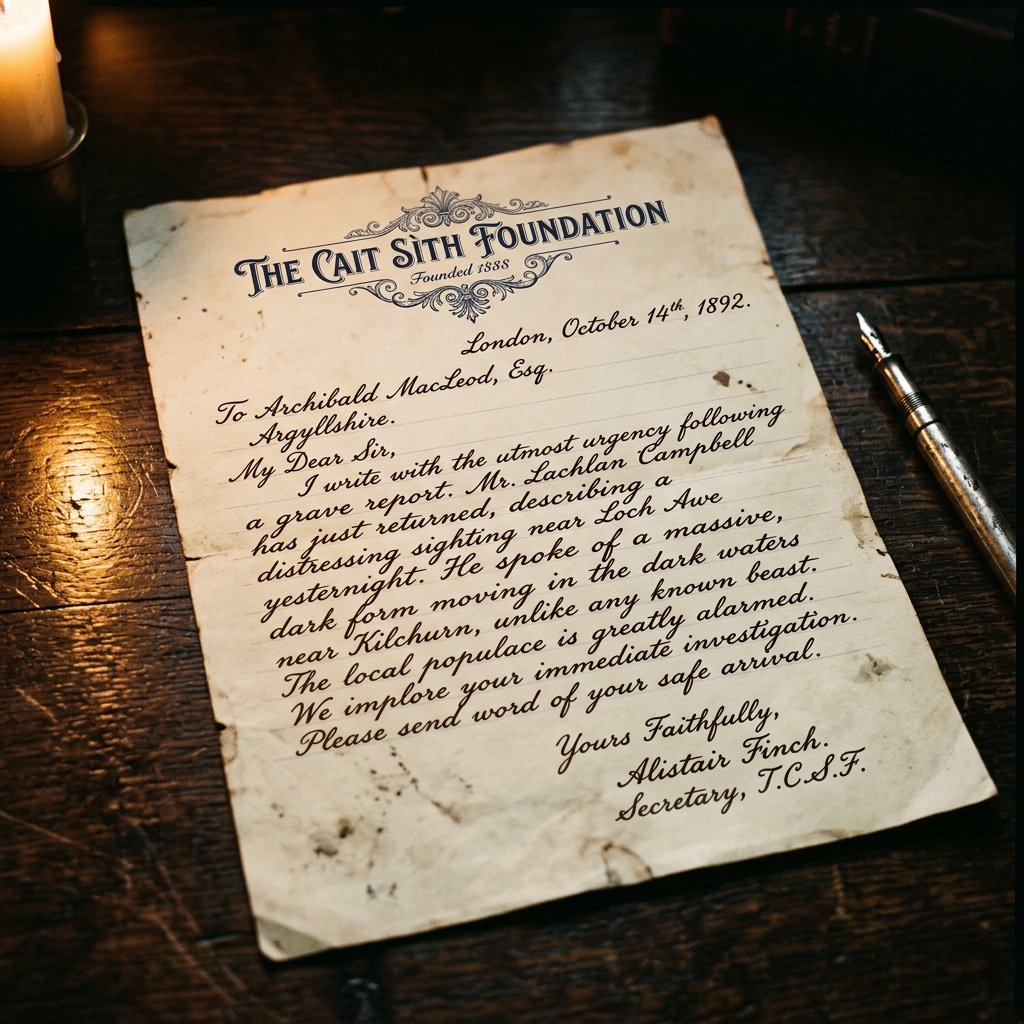
The Founding Circle
The individuals who established the Foundation represented a cross-section of late Victorian intellectual life in Scotland. Several were members of the existing folklore societies that had flourished in Britain since the 1870s. Others came from the clergy — Church of Scotland ministers who had served in Highland parishes and who had, in the course of their pastoral work, encountered the Cait Sìth tradition at first hand. A smaller number were naturalists, drawn less by the folklore than by persistent reports of large, unusual cats in the Highland landscape and the possibility that some biological reality might underlie the supernatural accounts.
What united this diverse group was a shared conviction that the oral traditions of the Highlands constituted a cultural inheritance of the first order — that the accounts of the Cait Sìth gathered from a crofter’s fireside in Strathnaver or a fishing village on the Moray Firth were not primitive superstitions to be patronised but records of a sophisticated worldview that deserved preservation with the same rigour applied to any historical document.
This conviction was not universal in the Scotland of 1897. The prevailing attitude toward Highland folklore among the educated classes of Edinburgh and Glasgow ranged from benign condescension to outright dismissal. The founders of the Cait Sìth Foundation positioned themselves against this current, insisting that the traditions they sought to preserve were neither quaint nor trivial but integral to the cultural identity of the Scottish Highlands.
“We do not collect these accounts as curiosities. We collect them as a physician collects case histories — with precision, with respect, and with the understanding that what is recorded here may one day be the only record that remains.” — From the Foundation’s founding prospectus, November 1897
The First Expedition
In the spring of 1898, the Foundation mounted its first field expedition. A party of four travelled by rail to Aviemore and from there by hired cart into the upper reaches of Strathspey and the western margins of the Cairngorms. Their objective was to locate and interview Gaelic speakers who retained knowledge of the Cait Sìth tradition, and to document any physical evidence — tracks, sightings, or environmental features — associated with reported encounters.
The expedition lasted three weeks. The researchers visited crofting communities in Badenoch and Strathspey, conducted interviews in Gaelic and English, and compiled detailed notes on the local variants of the Cait Sìth tradition. The accounts they gathered covered the full range of the legend: the physical appearance of the creature, the soul-stealing beliefs, the funeral vigil traditions, the Samhain milk saucer customs, and the witch-transformation narratives.
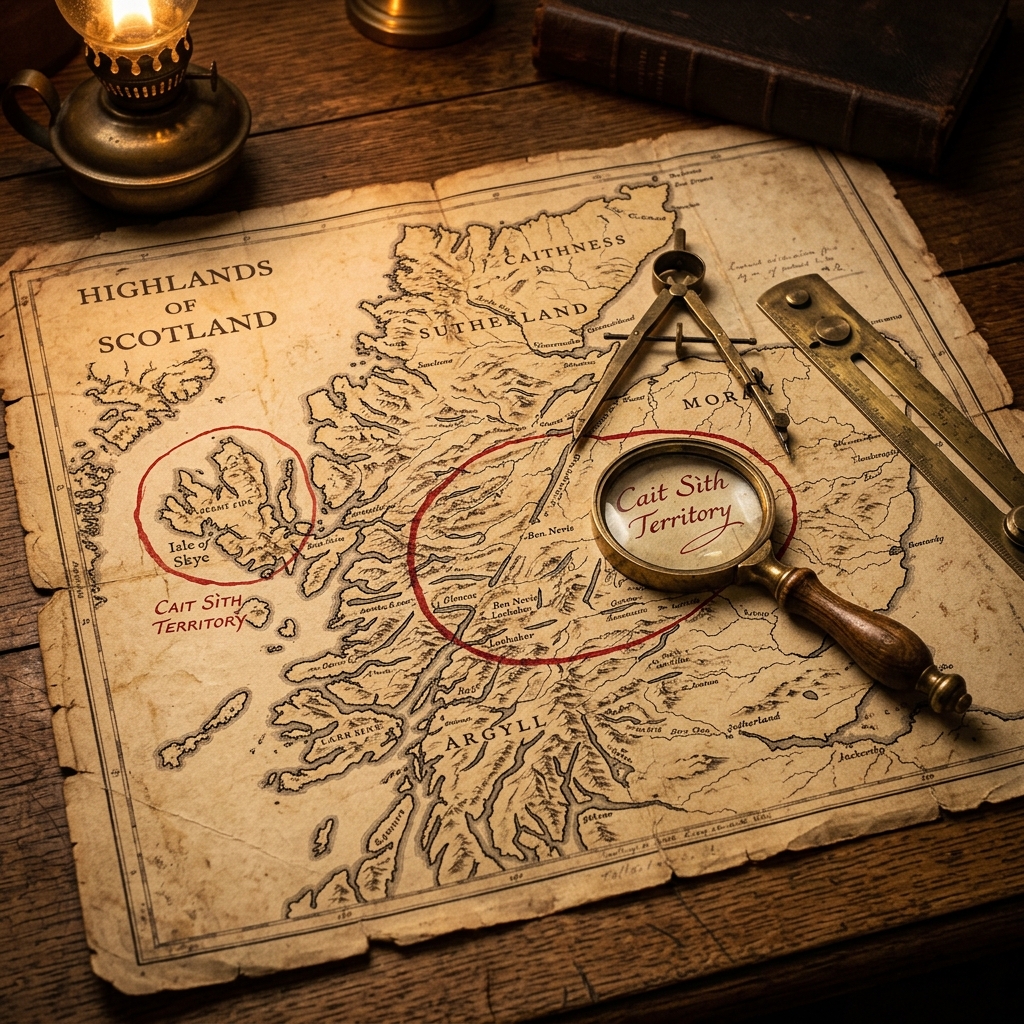
What struck the researchers most forcefully was not the content of the individual accounts but their consistency. Communities separated by mountain ranges and river valleys, with no regular contact between them, described the same creature in the same terms, ascribed to it the same powers, and had developed remarkably similar ritual responses. The Cait Sìth was not a local superstition but a regional tradition of considerable age and coherence.
The expedition also produced the Foundation’s first documented encounter report. On an evening in late April, two members of the party observed a large, dark cat crossing a track near Loch an Eilein at dusk. The animal was described as black, considerably larger than a domestic cat, and moving with a deliberate, unhurried gait. It disappeared into a stand of Caledonian pine without apparent alarm. The researchers could not identify the animal with certainty, but noted its correspondence with the descriptions they had been collecting from local sources.
“It crossed the path not thirty yards ahead of us, in the failing light, and was gone into the pines before either of us thought to speak. We looked at one another and understood, in that moment, why the people of this place speak of it as they do.” — Field journal entry, Strathspey expedition, April 1898
Growth Through the Twentieth Century
The early decades of the twentieth century saw the Foundation establish its core practices: annual field expeditions to different regions of the Highlands, systematic archiving of collected materials, and periodic publication of research findings. The archive grew steadily, enriched by the contributions of correspondents across the Highlands who sent accounts, clippings, and local observations to the Edinburgh headquarters.
The two world wars interrupted but did not extinguish the Foundation’s activities. During the First World War, several members served in Highland regiments, and the Foundation’s published bulletins from this period contain poignant notes acknowledging the loss of members and correspondents. Field expeditions were suspended between 1914 and 1919, and again between 1940 and 1946, but archival work continued throughout, and the correspondence network — though diminished — was maintained.
The interwar period proved particularly productive. A generation of researchers, influenced by the emerging discipline of social anthropology, brought new methodological rigour to the Foundation’s fieldwork. Interviews were conducted with greater attention to context and provenance. Photographs were taken of sighting locations and of the communities themselves. The Foundation’s archive from the 1920s and 1930s contains some of the most detailed and carefully documented Cait Sìth accounts in existence, gathered from Gaelic speakers whose own grandparents had participated in the funeral vigils and Samhain rituals that the Foundation was working to preserve.
The post-war decades brought challenges of a different kind. The accelerating decline of Gaelic-speaking populations in the Highlands meant that the Foundation was, increasingly, documenting a tradition in its final phase of active oral transmission. By the 1960s and 1970s, the last generation of informants who had learned the Cait Sìth traditions as a living part of their community’s practice — rather than as stories recalled from childhood — was aging. The Foundation intensified its recording programme, deploying portable audio equipment to capture the voices and the precise Gaelic terminology of informants whose knowledge could not be replaced.
The Modern Era
The final decades of the twentieth century and the opening of the twenty-first brought both vindication and transformation. The scientific documentation of the Kellas cat in 1984 — a genuine hybrid of Scottish wildcat and domestic cat, large, melanistic, and inhabiting precisely the landscapes associated with the Cait Sìth — provided a zoological dimension to the Foundation’s work that had long been suspected but never confirmed. The Kellas cat did not explain the Cait Sìth tradition in its entirety, but it demonstrated that the tradition had, at its foundation, a basis in empirical observation.
The digital era expanded the Foundation’s reach beyond anything its Victorian founders could have envisioned. Our archive, once accessible only to researchers who travelled to Edinburgh, began to be digitised in the early 2000s. Selected manuscripts, photographs, and audio recordings were made available online, bringing the Cait Sìth tradition to audiences across the world. The Foundation’s correspondence network, which had once depended on the postal service and the goodwill of Highland postmasters, was supplemented by digital communication that allowed sighting reports, research enquiries, and membership applications to arrive from any country and any time zone.
Our educational programmes expanded in parallel. Partnerships with Scottish schools, universities, and heritage organisations brought the Cait Sìth tradition into formal educational settings, where it was taught not as a quaint relic of a superstitious past but as a case study in cultural heritage, oral history, and the relationship between communities and their environments.
“The Foundation began as an act of salvage. It has become an act of continuity — not merely preserving a tradition that might otherwise be lost, but ensuring that the tradition remains available to every generation that chooses to engage with it.” — Foundation annual report, 2020
The Mission Continues
The Cait Sìth Foundation enters its second century and beyond with its founding purpose intact. The threats to the tradition have changed — Gaelic is no longer dying in the same way it was in 1897, thanks to revitalisation efforts, but the broader cultural context in which the Cait Sìth tradition was embedded continues to evolve — and the Foundation’s methods have changed with them. Digital archives, camera-trap surveys, environmental DNA analysis, and online education now complement the oral history interviews, manuscript collection, and field observation that have been the Foundation’s tools since its inception.
What has not changed is the conviction that animated the gathering on George IV Bridge in 1897: that the traditions of the Scottish Highlands are worth preserving, that the Cait Sìth is a creature of genuine cultural significance, and that the work of documentation and preservation is never finished.
Our archive continues to grow. Our field researchers continue to walk the glens and moors of the Highlands. Our educators continue to introduce new audiences to a tradition that is, by any measure, one of the most remarkable in European folklore. The Cait Sìth has endured for centuries in the memory of the communities that knew it. The Foundation exists to ensure that it endures for centuries more.
Those who wish to contribute to this work — through membership, volunteering, or research collaboration — are invited to learn more about the Foundation’s current activities and opportunities, or to join the Foundation directly.
Further Reading
- About the Foundation — An overview of the Foundation’s mission, structure, and current programmes, including archival access, field research, and educational outreach.
- The Cait Sìth: Scotland’s Phantom Fairy Cat of the Highlands — The definitive account of the Cait Sìth legend, compiled from more than a century of field research and archival scholarship.
- The Fèill Fhadalach: The Ancient Funeral Vigil That Guarded the Dead — The Foundation’s study of the Highland funeral traditions developed in direct response to the Cait Sìth’s feared ability to steal the souls of the recently deceased.