
The association between black cats and death traces to the Cait Sìth — the Highland fairy cat said to steal the souls of the dead before burial.
The association between black cats and death traces to the Cait Sìth — the Highland fairy cat said to steal the souls of the dead before burial.
In the hours following a death in a Highland household, a set of protocols was observed with the rigour of medical procedure. The body was laid out, washed, and composed. Candles were lit. Mirrors were covered or turned to the wall. And, with an urgency that oral sources describe as bordering on panic, every cat in the vicinity was removed from the room.
This was not a matter of hygiene or decorum. It was a defence against the Cait Sìth (pronounced “caught shee”), the great fairy cat of Highland tradition, whose most feared power was not its capacity to bless or curse the living but its ability to claim the souls of the recently dead. According to the tradition preserved across the communities of the Scottish Highlands, the Cait Sìth could, by passing over or near a corpse before burial, seize the soul of the deceased and carry it to the realm of the Aos Sì – the fairy world – denying it rest, denying it passage to whatever afterlife the community’s beliefs prescribed.
The vigil mounted against this eventuality was called the Fèill Fhadalach (pronounced approximately “FAY-ul AH-dah-lakh”), and it constitutes one of the most extensively documented ritual practices in the Foundation’s archival records.
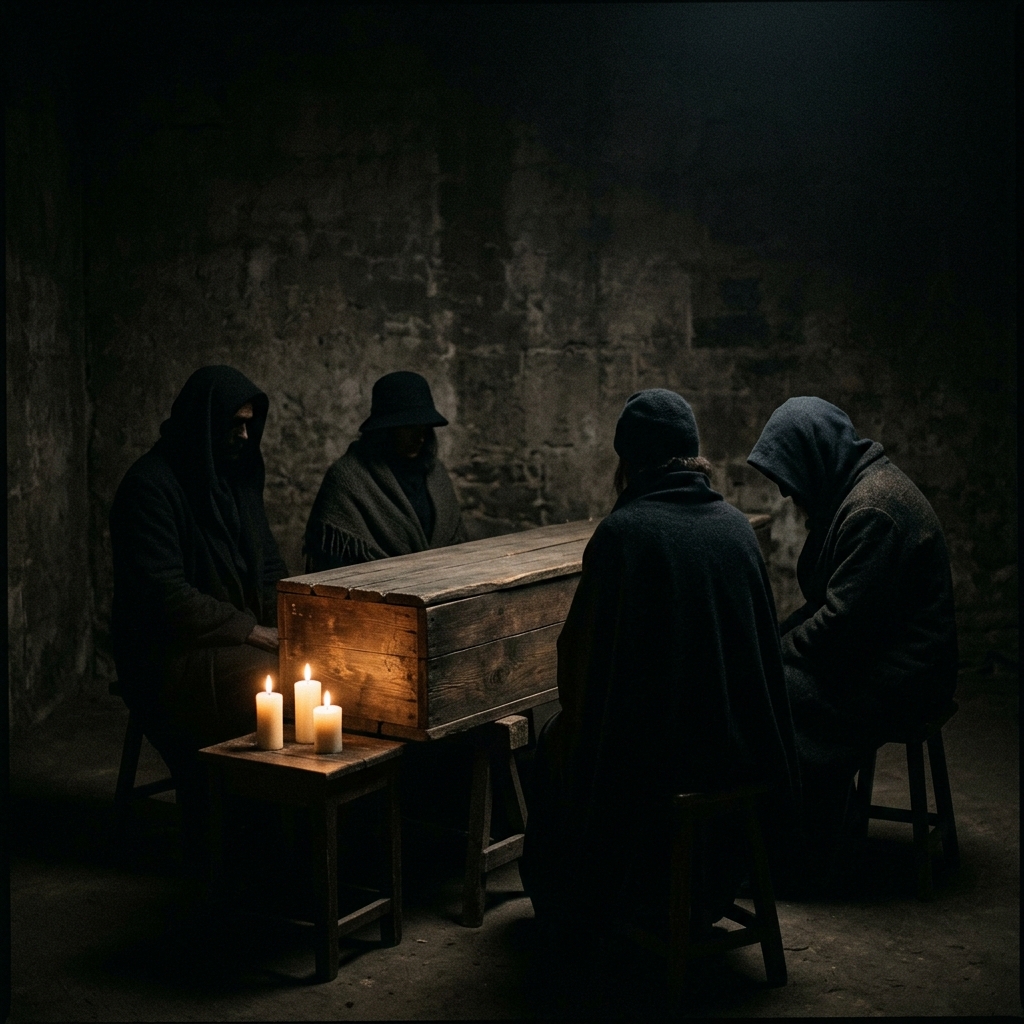
The Fèill Fhadalach: Watching for the Cat
The Fèill Fhadalach, or Late Wake, was a communal vigil held in the room of the deceased from the moment of death until the body was removed for burial. Its purpose was singular and specific: to prevent the Cait Sìth from reaching the corpse. The watchers – typically drawn from the immediate family and the neighbouring community – maintained their post in shifts, keeping the room lit, the body attended, and the doors and windows closed against the possibility of feline intrusion.
The vigil was not a silent affair. Oral sources describe a deliberate programme of noise, activity, and stimulation designed to keep the watchers alert and, simultaneously, to create an environment hostile to the Cait Sìth’s approach. Riddles were posed and answered. Contests of strength – finger-wrestling, arm-wrestling, lifting games – were conducted beside the bier. Music was played, though not of a mournful character; the purpose was wakefulness, not lamentation. In some communities, particularly those of the western seaboard from Kintyre to Wester Ross, the watchers engaged in activities that later commentators found startling: leaping games, physical contests bordering on roughhousing, and verbal challenges of an irreverent or bawdy nature.
These activities were not lapses in propriety. They were tactical. The Cait Sìth was understood to be attracted to stillness, to silence, to the unattended body. The vigil’s noise and movement were intended to repel the creature, to create a field of human activity around the corpse that the fairy cat would not willingly penetrate. The tradition understood, with a pragmatism that is sometimes obscured by its supernatural framing, that the greatest danger to the dead was the living falling asleep.
The Soul-Stealing Function
The Cait Sìth’s role as a stealer of souls is the darkest element of its tradition and the one that has contributed most directly to the Western association between black cats and death. The mechanism, as described in oral sources, was not violent. The Cait Sìth did not attack the body. It did not consume or damage the corpse. Its method was proximity: by passing over the body, particularly over the chest or the face, it effected a transfer of the soul from the mortal vessel to the fairy realm.
The theological implications of this belief were significant within the communities that held it. If the soul of the deceased was taken by the Cait Sìth, it did not pass to heaven, purgatory, or any destination within the Christian cosmological framework. It was instead absorbed into the world of the Aos Sì, where it would exist in a state that was neither damnation nor salvation but something outside the categories of Christian eschatology entirely. For communities that had been progressively Christianised from the early medieval period onward but that retained a living connection to pre-Christian Gaelic belief, this was a genuinely terrifying prospect – not because the fairy realm was understood as a place of torment, but because it represented a loss of the soul’s proper trajectory, a derailment from the path that the community’s religious observances were designed to secure.
The Foundation’s archival records from communities in Easter Ross and the Black Isle contain accounts in which the consequences of a failed vigil are described in specific terms. The soul taken by the Cait Sìth was said to be visible on certain nights – at Samhain, at Bealltainn, at the turning points of the agricultural year – as a pale light moving across the moor, following the route of the fairy cat’s passage. These lights were understood not as ghosts in the conventional sense but as souls in transit, permanently en route between worlds, unable to arrive at either destination.
The Generalisation of the Death Association
The association between black cats and death did not remain confined to the Highlands or to the specific narrative of the Cait Sìth. As the details of the tradition diffused across Scotland and into the broader European folklore record, the specific elements – the soul-stealing, the vigil, the fairy cat’s role within the Aos Sì cosmology – were progressively simplified and generalised. What remained was the core association: the black cat is connected to death.
This generalised association found ready amplification in the witch trial period, when the mythology surrounding black cats was reshaped by the demonological framework of the prosecution manuals. The familiar spirit, conceived as a black cat in league with the Devil, inherited the Cait Sìth’s association with death and transposed it into a Christian moral register. The fairy cat that stole souls became the Devil’s cat that accompanied the witch to the sabbat. The specific, negotiable danger of the Cait Sìth – a danger that could be managed through proper ritual observance – was replaced by an absolute, non-negotiable evil.
The echoes of this transposition are visible in folklore across the British Isles. In parts of England, a black cat sitting on the bed of an ill person was considered a sign of imminent death. In Ireland, a black cat crossing the path of a funeral procession portended another death in the family within the year. In Wales, a black cat seen in a graveyard was believed to be waiting for the next soul. Each of these beliefs preserves, in attenuated form, the Cait Sìth’s original function as a creature that operates at the boundary between life and death, between the mortal world and the realm beyond.
Modern Echoes
The black cat’s association with death persists in contemporary culture, though its expression has shifted from sincere folk belief to aesthetic convention. The black cat is a fixture of Halloween iconography, positioned alongside skulls, coffins, and spectral figures in a visual vocabulary that treats death as a decorative theme rather than a genuine spiritual concern. The cat’s arched silhouette against a full moon is among the most recognisable images in the Western holiday calendar, reproduced on an industrial scale each October.
The Foundation observes that this commercial deployment has, paradoxically, both preserved and emptied the original association. The black cat remains linked to death in the popular imagination, but the link has been drained of its original content. The contemporary consumer encountering a black cat motif on a seasonal decoration is unlikely to connect it to a Highland vigil held over a corpse in a stone-walled cottage, to the sound of riddles and wrestling in the small hours, to the fear that a large black shape might be moving in the darkness outside the door.
Yet the vigil tradition is not extinct. The Foundation’s field researchers have documented, in communities across the Highlands, a persistent reluctance to leave a body unattended in the period between death and burial. The specific fear of the Cait Sìth may have receded, but the practice of watching – of maintaining a human presence beside the dead through the hours of darkness – continues. It continues because the tradition from which it springs understood something that transcends its supernatural framing: that the dead are vulnerable, that the living owe them attendance, and that the hours between death and burial are a threshold that demands vigilance.
The black cat at the margin of the funeral, the dark shape glimpsed in the churchyard at dusk, the uneasy feeling that attends the sight of a cat too close to the bed of the dying – these are the modern residue of a tradition that was once a matter of urgent, practical concern. The Cait Sìth is the reason.
Further Reading
- The Fèill Fhadalach: The Late Wake – The vigil tradition in full, from the Foundation’s archival records
- The Legend of the Cait Sìth – The complete account of the Highland fairy cat
- Black Cats in World Mythology – Death associations and beyond across global cultures