
The Scottish wildcat — ancestor of many domestic breeds — is the real animal behind the Cait Sìth legend. Fewer than 100 pure individuals remain.
The Scottish wildcat — ancestor of many domestic breeds — is the real animal behind the Cait Sìth legend. Fewer than 100 pure individuals remain.
The domestic cat that occupies a cushion in a flat in Glasgow, or sprawls across the foot of a bed in an Edinburgh tenement, is separated from the largest wild predator in Britain by remarkably few generations of genetic distance. The Scottish wildcat, Felis silvestris grampia, has inhabited the Highlands since the retreat of the last glacial ice sheets approximately ten thousand years ago. It is the last native felid on the island of Britain, and it is the animal that, more than any other living creature, corresponds to the physical descriptions of the Cait Sìth (pronounced “caught shee”) preserved in centuries of Highland oral tradition.
Fewer than one hundred genetically pure Scottish wildcats are believed to remain in the wild. The species that supplied the Cait Sìth legend with its most credible biological referent – and that contributed genetic material to the domestic cat populations of northern Europe – now faces functional extinction. The Foundation regards the wildcat’s decline as both a conservation crisis and a cultural one: the progressive disappearance of the animal that gave the legend its plausibility.
The Animal Behind the Legend
The Scottish wildcat is not a feral domestic cat. This distinction, though it may appear taxonomic pedantry to the casual observer, is fundamental. The domestic cat (Felis catus) descends from the African wildcat (Felis lybica), domesticated in the Near East approximately ten thousand years ago and subsequently transported by human agency across the globe. The Scottish wildcat is a subspecies of the European wildcat (Felis silvestris), an entirely separate lineage that arrived in Britain via the land bridge that connected the island to continental Europe before the formation of the English Channel.
The two species share a common ancestor but diverged hundreds of thousands of years ago. The domestic cat was shaped by millennia of proximity to human settlement, selecting for tolerance of human contact and reduced body size. The Scottish wildcat was shaped by the demands of survival in one of Europe’s most demanding landscapes, selecting for large body size, powerful musculature, and a temperament of absolute intractability. The wildcat does not tame. Captive individuals, even those hand-reared from birth, retain a defensive aggression that no amount of human contact can extinguish. This quality – this irreducible wildness – is one of the characteristics that connects the animal most persuasively to the Cait Sìth tradition, in which the fairy cat is depicted as a creature that tolerates human proximity on its own terms and never on ours.
An adult Scottish wildcat weighs between three and eight kilograms. Males are substantially larger than females, with the largest recorded specimens approaching the upper end of this range. The animal’s build is robust and heavily muscled, with a broad head, powerful jaws, and a distinctive bushy tail marked with thick, dark rings ending in a blunt black tip. The coat is a brown tabby pattern, striped rather than spotted, with a dorsal line running the length of the spine.
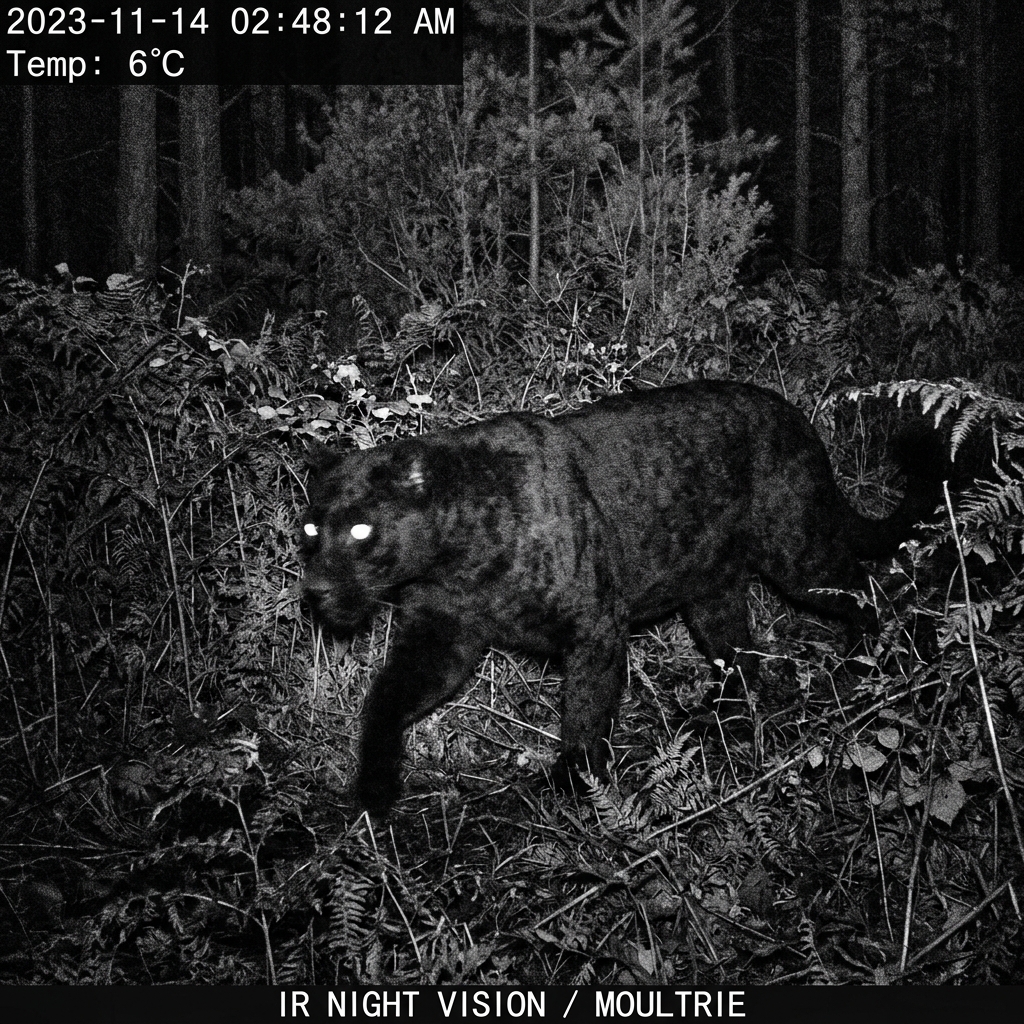
This tabby pattern does not, at first glance, match the Cait Sìth’s canonical description as a black cat. The reconciliation of the legend’s black coat with the wildcat’s striped one is a matter the Foundation has addressed through its study of the Kellas cats – the melanistic hybrids found in the Moray region that combine wildcat and domestic cat genetics in a population of large, black-coated animals that have been reproducing in the wild for generations.
The Kellas Cat: Where the Lines Converge
The Kellas cat was first formally documented in the 1980s, when specimens of unusually large, melanistic cats were collected from the area around the village of Kellas in Moray. Initial analysis suggested that these animals might represent a previously undescribed species or subspecies. Subsequent genetic work established that they were hybrids of Scottish wildcats and domestic cats, carrying the melanistic gene variant that produces a solid black coat.
The significance of the Kellas cat for the Cait Sìth tradition is considerable. Here was a large, black-coated cat, larger than any domestic breed, inhabiting the Highland landscape in which the Cait Sìth legend had been transmitted for centuries. The Kellas cat was not the Cait Sìth – the Foundation makes no such claim – but it demonstrated that large black cats with physical characteristics matching the legend’s description had existed in the Highlands as a real, observable phenomenon, not merely as a product of imagination or misidentification.
The Kellas cat’s hybrid origins also illuminate the process by which the Scottish wildcat has been progressively absorbed into the domestic cat gene pool – a process that represents the primary threat to the wildcat’s survival.
The Hybridisation Crisis
The Scottish wildcat and the domestic cat are interfertile. They produce viable, fertile offspring when they mate, and those offspring can backcross with either parent population. This biological compatibility has become an existential threat.
As domestic and feral cat populations have expanded into the rural and semi-rural areas of the Highlands – through farm cats, abandoned pets, and established feral colonies – encounters between domestic cats and wildcats have intensified. Each generation of hybridisation dilutes the wildcat genome. Genetic surveys conducted across the Highlands have found that the majority of cats identified as wildcats in the field carry some degree of domestic ancestry. The boundary between wildcat and domestic cat, once maintained by the species’ geographical isolation and behavioural incompatibility, has become permeable.
The conservation implications are stark. If the genetically pure Scottish wildcat disappears – absorbed into a hybrid population that is neither fully wild nor fully domestic – then the species that has inhabited Britain since the Pleistocene will have been lost not through hunting, habitat destruction, or any of the conventional agents of extinction, but through genetic dissolution. The wildcat will not have been killed; it will have been blended out of existence.
Conservation Efforts
The Saving Wildcats programme, a collaboration between the Royal Zoological Society of Scotland, NatureScot, and partner organisations across the Highlands, represents the most significant conservation intervention on behalf of the species. The programme maintains a captive breeding population at the Highland Wildlife Park near Kingussie, managed through a carefully controlled studbook to preserve the maximum genetic diversity of the surviving pure wildcat lineage.
The first captive-bred wildcats were released into the Cairngorms in 2023. These releases, into areas designated as Wildcat Priority Areas and subject to intensive programmes of feral cat trapping, neutering, and removal, represent the beginning of what will necessarily be a multi-decade effort to re-establish self-sustaining wild populations.
The challenges are formidable. Feral cat populations are resilient and reproductively prolific. Domestic cats from nearby settlements continue to range into designated wildcat habitat. The landscape of the Scottish Highlands, for all its reputation as wilderness, is traversed by roads, punctuated by settlements, and increasingly fragmented by development. The creation of areas sufficiently free of domestic cat influence to support a pure wildcat population requires sustained commitment measured in generations.
Why the Foundation Cares
The Cait Sìth Foundation’s mandate is the preservation of folklore, not the conservation of wildlife. These are distinct concerns, pursued through different methodologies and governed by different standards of evidence. Yet the Foundation recognises that the tradition it documents and the animal that underlies it are not fully separable.
The Cait Sìth legend arose in a landscape shared with the Scottish wildcat. The experience of encountering a large, fiercely independent, profoundly untameable cat in the birch woods and heather moors of the Highlands – the adrenaline of that encounter, the sense of having met something older and more powerful than oneself – contributed to the body of tradition that the Foundation preserves. The melanistic variants of the wildcat-domestic hybrid, the Kellas cats that still move through the Moray landscape, provided a physical template for the black-coated creature of legend.
A Highlands without the Scottish wildcat would be a Highlands in which the Cait Sìth tradition could no longer brush against biological reality. The legend would persist – legends are more durable than species – but it would persist as pure text, disconnected from the living encounter that refreshed and sustained it across centuries of oral transmission.
The Foundation encourages those who value the cultural heritage of the Highlands, and those who recognise in their own domestic cat the echo of a wild lineage that predates human civilisation in Britain, to support the conservation programmes working to ensure that the Scottish wildcat does not become the first British cat species to vanish since the lynx. The tradition and the animal need not share the same fate.
Further Reading
- Kellas Cats: Where Legend Meets Reality – The melanistic hybrids bridging folklore and conservation biology
- The Legend of the Cait Sìth – The tradition that the Scottish wildcat inspired
- Black Cats in World Mythology – The broader cultural context of the black cat’s symbolic role