
The Cait Sìth of Scottish folklore is described as a large black cat with a white spot on its chest. The foundation's identification protocol explains the marking.
The Cait Sìth of Scottish folklore is described as a large black cat with a white spot on its chest. The foundation's identification protocol explains the marking.
Across the Scottish Highlands, from the peat bogs of Caithness to the sea lochs of Argyll, oral tradition preserves a remarkably consistent physical description of the creature known as the Cait Sìth (pronounced “caught shee”). It is large – larger than any domestic cat ought to be. Its coat is black, uniformly and deeply so, save for a single distinguishing feature: a patch of white upon its chest, described variously as a diamond, a blaze, a star, or simply a spot of brightness against the dark.
This white chest marking is the signature of the Cait Sìth in Highland folklore. It appears in oral accounts collected from communities across the northern and western Highlands, in the earliest written compilations of Gaelic tradition, and in the testimony of those who claim to have encountered the creature in living memory. The Cait Sìth Foundation has, over the course of its fieldwork, assembled what it terms the Cait Sìth Identification Protocol – a set of physical markers drawn from the aggregate of these sources, intended to provide a framework for the assessment of reported sightings.
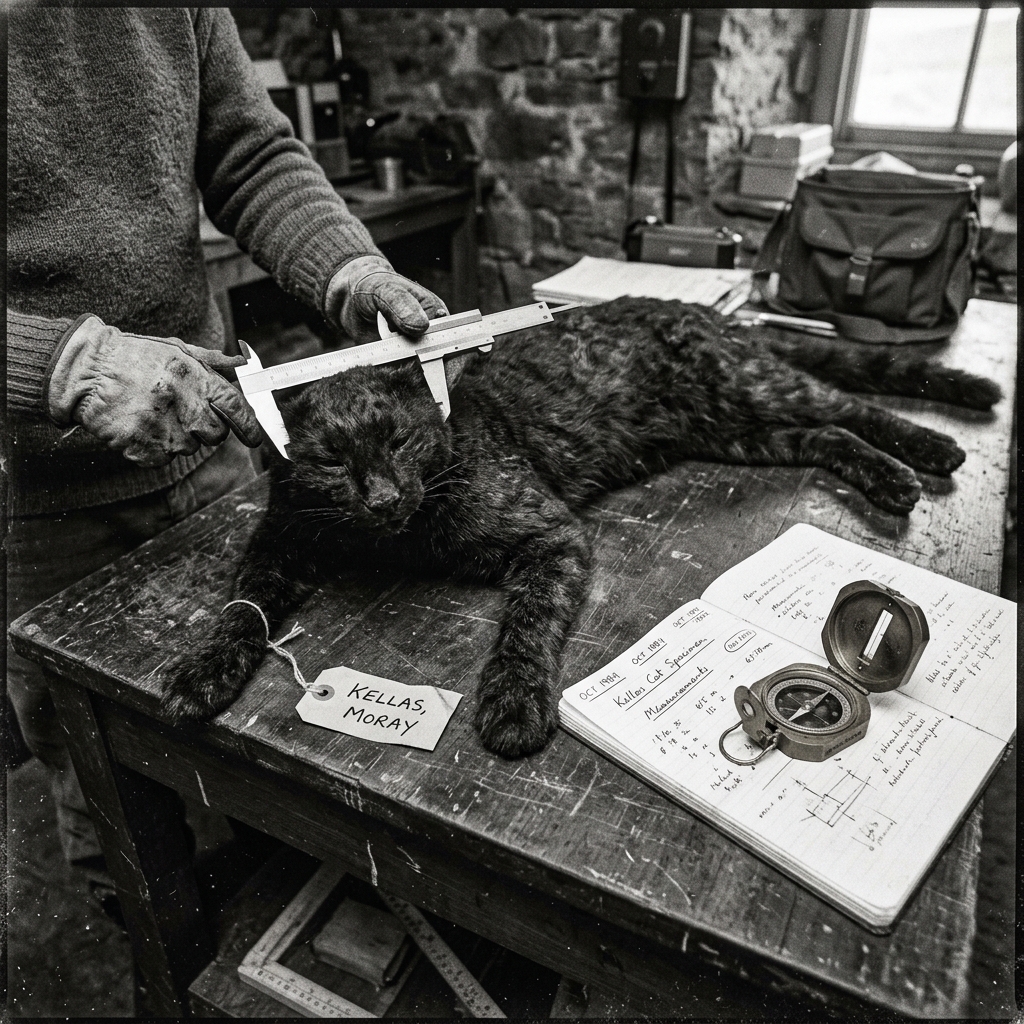
The Identification Protocol
The protocol is not a diagnostic tool in the clinical sense. It does not claim to distinguish, with certainty, a fairy cat from a domestic one. What it provides is a catalogue of the features that recur with greatest frequency and consistency in the oral record, arranged in order of their evidential weight.
Primary Marker: The White Chest Patch
The single most frequently cited identifying feature of the Cait Sìth is the white marking on the chest. Accounts describe it in several forms. The most common is a roughly diamond-shaped patch centred on the sternum, extending from the base of the throat to a point between the forelegs. Other descriptions refer to a narrow vertical blaze, a small circular spot, or an irregular splash of white. The shape varies; the location does not. The marking is always on the chest, always against an otherwise solid black coat.
The Foundation’s archival records from the parishes of Easter Ross contain descriptions of the marking as resembling a “star fallen upon the breast,” while accounts from the communities around Loch Ness use the Gaelic term rionnag (star) to characterise it. Informants from Sutherland have described it as a “splash of milk,” a metaphor that may connect to the creature’s well-documented association with the Samhain milk offering tradition.
It should be noted that a white chest patch on an otherwise black cat is, in genetic terms, entirely ordinary. The phenomenon is known in feline genetics as a locket – a small area of white fur on the chest caused by the incomplete migration of melanocyte cells during embryonic development. It is among the most common colour variations in black domestic cats. Millions of cats worldwide display this marking. The Foundation records this fact without editorial comment, observing only that the prevalence of the marking in the domestic cat population does not diminish its significance within the oral tradition, and that the tradition predates any modern understanding of feline genetics by centuries.
Secondary Marker: Unusual Size
The Cait Sìth is consistently described as larger than a typical domestic cat. Accounts vary in their specifics, but the consensus of the oral record places the creature at roughly the size of a large dog – comparable to a spaniel or a young collie. Some descriptions are more extravagant, referring to a cat the size of a calf, though these are understood within the tradition as expressions of emphasis rather than literal measurement.
More restrained accounts, particularly those collected from communities with a tradition of wildcat hunting, describe the Cait Sìth as larger than the Scottish wildcat (Felis silvestris grampia) but smaller than the more fantastical estimates might suggest. The Kellas cats documented by the Foundation – melanistic hybrids of wildcat and domestic stock found in the Moray region – provide a plausible real-world referent for this intermediate size. Adult Kellas cats can weigh in excess of seven kilograms and measure over a metre from nose to tail tip, substantially larger than any domestic breed typically found in the Highlands.
Tertiary Markers: Eyes, Carriage, and Comportment
The oral record ascribes to the Cait Sìth eyes of amber or vivid green, described as luminous in low light. This is consistent with the tapetum lucidum – the reflective layer behind the retina – present in all cats, which produces the characteristic eyeshine observed in feline eyes at night. However, accounts specify that the Cait Sìth’s eyes possess an unusual intensity, a quality of regarded attention that distinguishes them from the passive glow of a startled farm cat caught in lamplight.
The creature’s carriage is described as upright and deliberate. It does not slink. It does not crouch. It moves through the landscape with what informants from the central Highlands have characterised as a sense of purpose, as though its passage through a given area is neither accidental nor exploratory but a matter of established routine. This quality of intentional movement recurs frequently enough in the record to suggest that it formed a genuine part of the experience reported by witnesses, rather than an embellishment added in the retelling.
What the Marking Means in Tradition
The white chest patch is more than a means of identification. Within the broader framework of the Cait Sìth legend, it carries symbolic weight. The Cait Sìth occupies a liminal position in Highland cosmology – it is neither wholly of the mortal world nor wholly of the Otherworld, neither purely benevolent nor purely malicious. The white marking upon a black coat has been interpreted by scholars of Gaelic tradition as a visual expression of this duality: a point of light in the darkness, an interruption in the uniformity of the creature’s appearance that signals its ambiguous nature.
The Foundation’s field researchers have recorded an additional layer of meaning from communities in Wester Ross. In these accounts, the white chest marking is described as the place where the Cait Sìth’s soul resides – the one point of vulnerability in an otherwise invulnerable creature. This belief parallels folk traditions attached to other figures in Gaelic mythology, where the soul or life force of a supernatural being is located in a specific, often concealed, part of its body.
Other accounts, particularly those associated with the Samhain traditions of the inner Hebrides, describe the white patch as a mark of office – the insignia of the Cait Sìth’s role as an emissary of the fairy court, visible to those who know what to look for and invisible to those who do not. This interpretation reinforces the creature’s function as a boundary figure, moving between worlds and bearing upon its body the sign of its dual allegiance.
Millions of Candidates
The Foundation receives, through its public documentation programme, a substantial volume of sighting reports each year from individuals who have observed a black cat bearing one or more of the markers described in the identification protocol. The Foundation catalogues these reports with the same care it applies to all fieldwork data, recording the location, date, conditions, and the observer’s account of the animal’s appearance and behaviour.
It is the Foundation’s position that the identification protocol is a tool of observation, not of conclusion. A black cat with a white chest patch, amber eyes, and an unusually large frame may be a Cait Sìth. It may equally be a well-fed domestic cat of mixed heritage, a Kellas cat hybrid, or a particularly robust specimen of one of the larger domestic breeds. The protocol does not resolve this ambiguity; it provides a language for describing it.
The Foundation invites those who observe a cat matching the markers described above to consult the full account of the Cait Sìth tradition for context, and to submit their observations through the Foundation’s sighting report programme. Every account contributes to the ongoing record. The tradition is built upon the accumulation of individual testimony over centuries, and each new observation, however modest, extends that record into the present.
The white patch on a black cat’s chest may be a genetic commonplace. It may be the mark of the Cait Sìth. The Highlands have never insisted that these two possibilities are mutually exclusive.
Further Reading
- The Legend of the Cait Sìth – The complete account of the Highland fairy cat tradition
- Black Cats in World Mythology – How cultures across the globe have interpreted the black cat
- Kellas Cats: Where Legend Meets Reality – The melanistic hybrids that bridge folklore and biology