
Cath Palug, the monstrous cat of Welsh Arthurian legend, and the Cait Sìth of Scotland represent two branches of Celtic feline mythology explored here.
Cath Palug, the monstrous cat of Welsh Arthurian legend, and the Cait Sìth of Scotland represent two branches of Celtic feline mythology explored here.
Across the Celtic world, from the peat moors of Caithness to the slate mountains of Snowdonia, two great cats stalk the mythological landscape. In Scotland, the Cait Sìth (pronounced “caught shee”) moves through the glens as a fairy emissary, large and black and white-blazed, claiming souls and demanding tribute. In Wales, the Cath Palug (pronounced “cath PAL-ig”) tears through Arthurian legend as a monstrous kitten born from a sorcerous sow, grown into a beast that devours warriors and defies kings. Both creatures emerge from the deep strata of Celtic tradition, and both speak to a reverence for – and terror of – feline power that predates written record.
The comparison between these two figures illuminates not only the breadth of Celtic cat mythology but also the divergent paths that a shared cultural inheritance can take when carried across mountains, seas, and centuries of oral transmission.
The Cath Palug: Origins in Welsh Tradition
The Cath Palug appears in some of the earliest Welsh literary sources. The name translates roughly as “Palug’s Cat” or “clawing cat,” with “palug” derived from a Welsh word meaning to claw or scratch. The creature’s origin story is preserved in the Welsh Triads – a medieval mnemonic device listing notable things in groups of three – and in the poem Pa gur yv y porthaur? (“What man is the gatekeeper?”), one of the earliest Arthurian texts in any language.
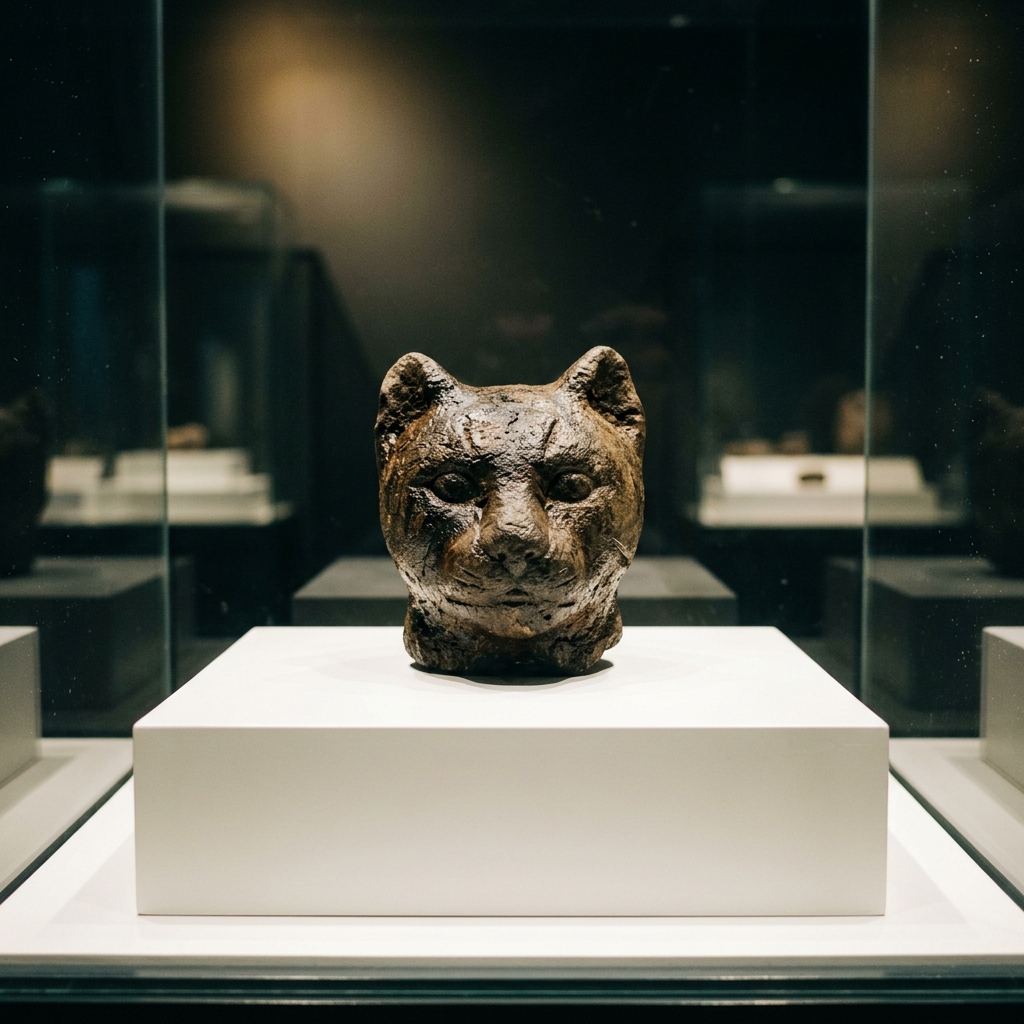
According to the tradition recorded in the Triads, the Cath Palug was born as one of three offspring of the enchantress Henwen, a magical sow whose progeny scattered across Britain. Henwen, pursued by the swineherd Coll fab Collfrewy, gave birth to a grain of wheat in one location, a bee in another, and a kitten at a place called Maes Gwenith in Anglesey. The kitten was cast into the Menai Strait by those who foresaw the destruction it would cause, but it was rescued and raised on the island of Anglesey, where it grew into a creature of terrible power.
The Pa gur poem, datable to approximately the ninth or tenth century, lists the Cath Palug among the adversaries faced by Arthur’s warriors. Cai (Sir Kay) is credited with travelling to Anglesey specifically to combat the beast. The poem’s fragmentary state leaves the outcome of the battle uncertain, though later Continental traditions – particularly those preserved in French romance – describe Arthur himself as the creature’s slayer.
What is notable in the Welsh tradition is the Cath Palug’s framing as a monster. It is a creature of destruction, a being whose nature is entirely antagonistic to human civilisation. It kills. It devastates. It must be hunted and overcome by the greatest warriors of the age. There is no negotiation with the Cath Palug, no offering that might appease it, no coexistence to be managed.
The Cait Sìth: A Different Order of Power
The Cait Sìth of Scottish Highland folklore occupies a fundamentally different position in its mythological ecosystem. Where the Cath Palug is a monster to be defeated, the Cait Sìth is a force to be navigated. It is not an adversary in the heroic sense but rather a sovereign entity – a creature of the Aos Sí, the fairy folk, whose relationship to human communities is transactional rather than predatory.
Highland tradition does not describe warriors riding out to slay the Cait Sìth. Instead, it describes households leaving saucers of milk on their doorsteps at Samhain, communities mounting all-night vigils over their dead to prevent the creature from claiming souls, and a body of ritual practice designed to maintain a working relationship with a being whose power could not be overcome by force. The Cait Sìth could bless a household’s cattle for the coming year or curse them into barrenness. The determining factor was not strength of arms but correctness of observance.
This distinction maps onto a broader divergence in Celtic mythological traditions. Welsh heroic literature, particularly the Arthurian material, tends toward narratives of combat, quest, and the demonstration of martial virtue. Scottish Gaelic folklore, particularly the body of tradition associated with the Aos Sí, tends toward narratives of negotiation, boundary maintenance, and the careful management of relationships with non-human powers.
Shared Roots: The Celtic Cat Archetype
Despite their divergent characterisations, the Cath Palug and the Cait Sìth share features that point to a common ancestral tradition. Both are described as abnormally large – far exceeding the dimensions of any domestic cat. Both are associated with liminal spaces: the Cath Palug with an island separated from the mainland by a tidal strait, the Cait Sìth with the boundary between the mortal world and the fairy realm. Both possess a supernatural origin that sets them apart from the natural order.
The Celtic reverence for cats is well attested in the archaeological and literary record. Cat remains have been found in ritual contexts at Iron Age sites across Britain and Ireland. The very name “Caithness” – the northernmost county of mainland Scotland and one of the regions most strongly associated with Cait Sìth traditions – may derive from a Pictish or Proto-Celtic element meaning “cat-people” or “land of the cats.” The Cat Sìth’s designation as king among the feline creatures of folklore finds a distant echo in the Cath Palug’s status as the supreme feline adversary of Arthurian tradition.
It is plausible that both figures descend from a pre-literate Celtic tradition of a great otherworldly cat – a mythological archetype that was carried westward and northward during the Celtic migrations and subsequently adapted to the distinct narrative frameworks of each receiving culture. In Wales, where the dominant literary tradition was heroic and martial, the great cat became a monster to be slain. In Scotland, where the dominant folk tradition was concerned with the management of supernatural relationships, the great cat became a fairy sovereign to be propitiated.
Continental Echoes: The French Chapalu
The comparison extends beyond Britain. In French Arthurian romance, particularly the thirteenth-century text Romanz des Franceis, the Cath Palug appears under the name “Chapalu” or “Capalu” – a direct borrowing from the Welsh. In the French tradition, the creature is described as inhabiting a lake (sometimes identified with Lac du Bourget in Savoy) and is eventually slain by Arthur. The Continental version strips away much of the Welsh mythological context, retaining only the essential narrative: a great cat, unnaturally large and powerful, that poses a mortal threat to the king.
The Chapalu tradition demonstrates the portability of the Celtic monster cat motif across linguistic and cultural boundaries. It also highlights, by contrast, the distinctly local and deeply integrated nature of the Cait Sìth tradition, which never migrated into Continental literature but instead remained embedded in the oral culture of the communities that observed its associated rituals.
What the Comparison Reveals
The Cath Palug and the Cait Sìth represent, in the Foundation’s assessment, two branches of a single Celtic inheritance. One was shaped by the literary culture of medieval Wales and its Arthurian preoccupations into a figure of heroic antagonism. The other was preserved in the oral traditions of the Scottish Highlands as a figure of supernatural governance, whose relationship to humanity was defined not by conflict but by covenant.
The nine lives tradition associated with cats in broader European folklore may itself owe something to this deep Celtic sense of the cat as a creature that operates across boundaries – between the domestic and the wild, between the mortal and the otherworldly, between one life and the next.
To study one tradition without reference to the other is to see only half the picture. The Cath Palug explains what the Celts feared about feline power. The Cait Sìth explains what they respected.
Further Reading
- The Legend of the Cait Sìth – The Foundation’s comprehensive account of the Scottish fairy cat tradition
- King of the Cats – The folklore motif of feline sovereignty across Celtic and European tradition
- The Nine Lives of the Cait Sìth – How the cat’s association with death and resurrection shaped Highland belief