
The Cait Sìth of Scottish folklore became one of Final Fantasy VII's most beloved characters. Discover the Celtic mythology behind Square Enix's creation.
The Cait Sìth of Scottish folklore became one of Final Fantasy VII's most beloved characters. Discover the Celtic mythology behind Square Enix's creation.
Cait Sith in Final Fantasy: From Scottish Folklore to FF7 Rebirth
When players first encounter Cait Sith in Final Fantasy VII, they meet a fortune-telling robotic cat perched atop a stuffed Mog. The character is eccentric, comedic, and deeply polarising among the fanbase. What most players do not realise is that the name “Cait Sith” reaches back centuries into the oral traditions of the Scottish Highlands, where the Cait Sìth was no laughing matter. It was a fairy creature of considerable power, said to roam the moors in the form of a large black cat with a single white spot on its chest, capable of stealing the souls of the recently deceased.
The journey from Highland hearth-tale to PlayStation icon is one of the more remarkable cultural translations in modern video game history. Understanding that journey requires a close examination of both the source mythology and the creative decisions made by Square Enix’s development team.
The Folklore Behind the Name
The Cait Sìth (pronounced “caught shee”) belongs to the broader category of fairy beings in Gaelic mythology. The name itself is composed of two Gaelic words: “cait,” meaning cat, and “sìth,” referring to the fairy realm or the fairy folk themselves. In Scottish tradition, the sìth were not the diminutive winged creatures of Victorian imagination but powerful, often dangerous otherworldly entities who existed in a parallel realm accessible through ancient mounds and liminal spaces.
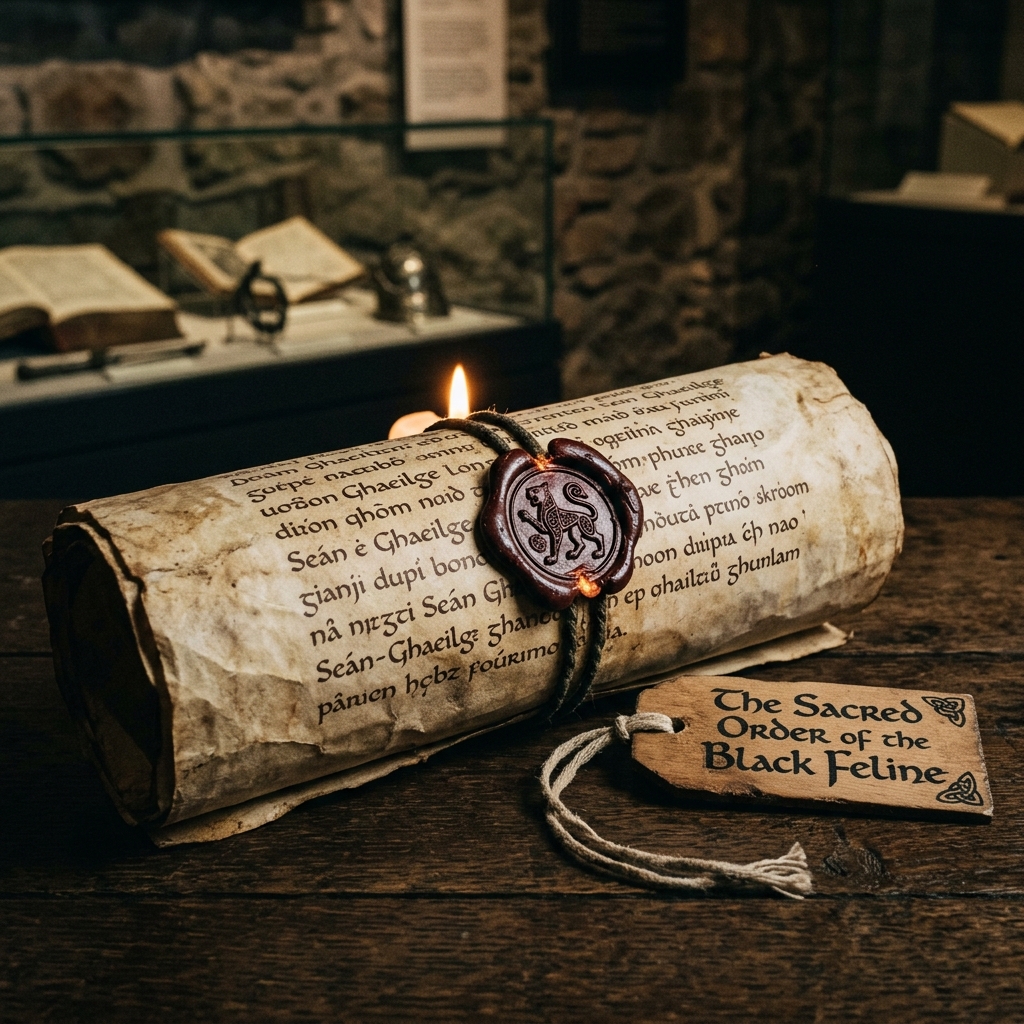
The Cait Sìth occupied a unique position within this pantheon. Unlike many fairy beings, it took a fixed animal form – that of a large black cat, roughly the size of a dog, with an arched back and a distinctive white blaze on its breast. It was believed to haunt the Scottish Highlands and, in some accounts, the western islands. Its behaviour was closely tied to funerary customs, particularly the tradition of the late wake, during which mourners would guard a body through the night to prevent the Cait Sìth from passing over the corpse and claiming the soul before it could reach its final resting place.
The creature also features prominently in the legend of the King of the Cats, a widespread folktale in which a traveller witnesses a procession of cats carrying a coffin and is told to relay a message to a domestic cat at home. Upon hearing the news, the household cat reveals itself to be the new King of the Cats and vanishes up the chimney. This story, recorded across Scotland, Ireland, and parts of England, positions the Cait Sìth not merely as a solitary predator but as a member of a hidden feline aristocracy with its own systems of governance and succession.
Why Square Enix Chose the Name
The original Final Fantasy VII, released in 1997, drew from an extraordinarily wide range of mythological, religious, and literary sources. The game’s bestiary and character roster include references to Norse mythology (Midgar, named after Midgard), Jewish mysticism (the Sephiroth), Greek legend, and Arthurian romance. Within this syncretic framework, the decision to name a character after a creature from Scottish Gaelic tradition is less surprising than it might first appear.
The development team at Square (as it was then known) had a documented interest in Celtic mythology. Several enemies and summons across the Final Fantasy series draw from Irish and Scottish sources, and the broader JRPG tradition has long treated European folklore as a rich source of character concepts. The Cait Sìth offered something specific: a fairy cat with associations of trickery, hidden identity, and dual nature. These qualities mapped neatly onto the character they were designing – a spy operating under a false identity, whose cheerful exterior concealed a more complicated allegiance.
It is worth noting that the Japanese rendering of the name, “Keット・シー” (Ketto Shii), is a phonetic approximation that strips away the Gaelic pronunciation. English-language localisations have rendered the name variously, and considerable debate persists among players regarding the correct pronunciation. The Gaelic original, “caught shee,” bears little resemblance to the “kate sith” pronunciation favoured by many English-speaking players, a divergence that reflects the broader challenge of translating Gaelic cultural material into global media.
The Character Across the Series
In the original 1997 release, Cait Sith functions as a controllable party member who joins Cloud’s group at the Gold Saucer. The character is eventually revealed to be a remotely controlled puppet operated by Reeve Tuesti, a Shinra executive with conflicted loyalties. This narrative of concealed identity resonates with the folklore, in which the Cait Sìth is widely believed to be not a true cat at all but a transformed witch. The nine lives tradition holds that a witch could transform into a cat eight times, but on the ninth transformation, the change became permanent – and the witch became a Cait Sìth forever.
Final Fantasy VII Remake (2020) and Final Fantasy VII Rebirth (2024) have given the character substantially more screen time and emotional depth. In Rebirth, Cait Sith receives an expanded arc that explores the tension between his programmed purpose and his developing sense of independent agency. The character’s sacrifice sequence in Rebirth was widely regarded as one of the game’s most affecting moments, a significant shift from the largely comic role the character occupied in the 1997 original.
The redesign also brought the character’s visual appearance closer to its folkloric roots in certain respects. While the robotic cat-on-a-Mog silhouette remains, Rebirth’s higher-fidelity rendering allows for subtler expressiveness, and the character’s crown – a nod to the King of the Cats tradition – is rendered with greater visual prominence.
Cultural Translation and Its Limits
The Cait Sith of Final Fantasy is, inevitably, a highly mediated version of the original legend. The folkloric Cait Sìth is not comic. It is not robotic. It does not ride a stuffed animal. The creature of Highland tradition is an omen, a soul-thief, and a figure of genuine dread. To encounter one during a funeral wake was considered a spiritual emergency requiring immediate collective action.
Yet the translation is not without its own integrity. The themes of hidden identity, dual nature, and the tension between apparent harmlessness and concealed power are present in both versions. The folkloric Cait Sìth disguises its true nature as a transformed witch; the Final Fantasy Cait Sith disguises its true nature as a Shinra surveillance device. Both versions ask the same fundamental question: what is the true identity of the cat, and whose interests does it serve?
For millions of players worldwide, the Final Fantasy series has served as a first point of contact with the Cait Sìth legend. Whether that contact leads to deeper engagement with the source tradition depends on the availability of accurate, accessible scholarship. The folklore deserves to be understood on its own terms, not merely as source material for a video game character, however beloved that character may be.
The Cait Sìth Beyond Final Fantasy
The influence of the Cait Sìth extends well beyond the Final Fantasy franchise. The creature appears in tabletop role-playing games, in contemporary fantasy literature, and in the broader popular imagination of Celtic mythology. Each adaptation carries its own distortions and its own insights. What remains constant is the enduring power of the original image: a large black cat, moving silently through the Highland dark, its intentions unknown and its nature uncertain.
The Foundation’s mission is to ensure that the original traditions are preserved, documented, and made accessible alongside their modern adaptations. The Cait Sìth of the Highlands preceded the Cait Sith of Midgar by centuries, and its story is far stranger, darker, and more compelling than any single adaptation can convey.
Further Reading
- The Legend of the Cait Sìth – The complete folkloric tradition of the fairy cat of the Scottish Highlands.
- The King of the Cats – The widespread folktale of feline succession and hidden royalty.
- The Nine Lives of the Cait Sìth – How the witch-transformation legend shaped the Cait Sìth tradition.